| |||||
| INTERNAL CARDS/BOARDS | |||||

|
|||||
|
Expansion Slot #1(Left):Slot #1 Primary Use: Modem connectivity Capabilities: Accepts modems like the ADAMLink 300 baud modem and SYDModem 1200 baud modem for telecommunications. Also supports the OHS Clock/Calendar Card for real-time clock functionality. Features: External connections through air vents, telephone line connectivity, Hayes AT command compatibility. Expansion Slot #2 (Center):Slot #2 Primary Use: Interface cards and hard drive systems Capabilities: Most versatile slot, accepting: PIA-2 Parallel Interface Card (for dot matrix printers) Multi-Purpose Interface Board (RS-232 ports, parallel port, memory addressing) POWERMATE Hard Drive System (complete storage expansion) ADDRESSER-CARD (memory expander connectivity) Features: Supports multiple simultaneous functions, enables high-resolution graphics printing, external terminal connections, hard drive support up to 40MB drives. Expansion Slot #3 (Right):Slot #3 Primary Use: Memory expansion Capabilities: Dedicated to RAM expansion cards ranging from 64K to 1MB Features: Provides print spooling for AdamCALC, RAM disk functionality for CP/M and T-DOS, copy buffer for disk operations, extended workspace for SmartWriter. Notable Products: Various memory expanders from 64K (Coleco, EVE, Orphanware) up to 1MB (MegaRAM). Each slot was designed with specific functionality in mind, with Port TWO being the most versatile for general expansion, Port ONE for communications, and Port THREE specifically for memory enhancement. 
COLECO ELECTRONICS
Collected
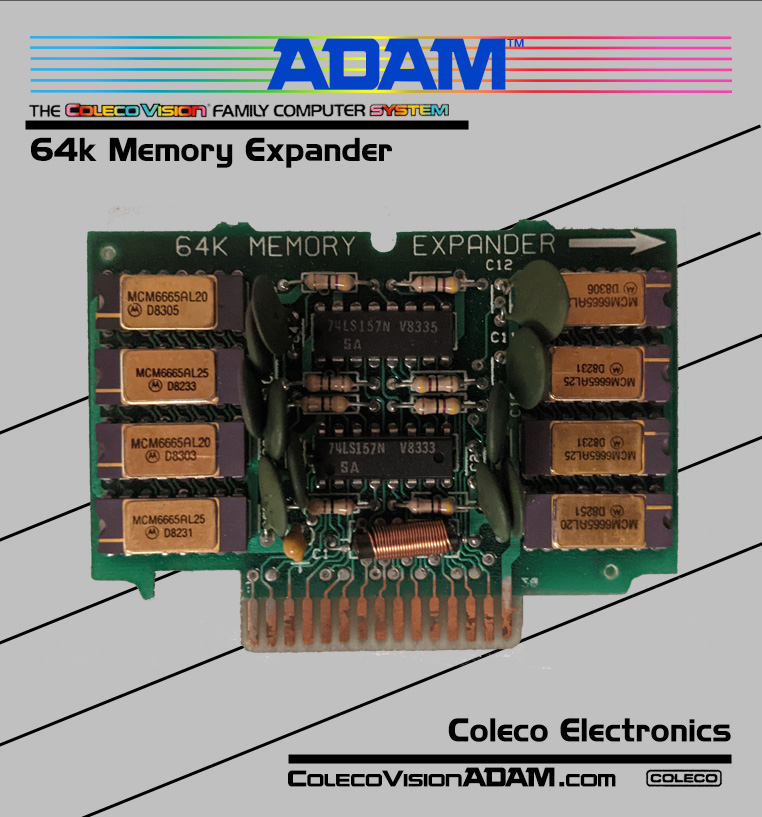
64K Memory Expansion Card v2 Slot #3When the ADAM left the factory it carried 80K of memory — 64K of working RAM plus 16K reserved for the video display. That was generous for 1983, but large documents and programs filled it quickly. This Coleco 64K Memory Expansion Card plugs into internal expansion slot #3 (the slot Coleco set aside specifically for memory) and raises the system total to 144K. The extra memory is felt most in SmartWriter, the ADAM's built-in word processor: it adds roughly 64,000 characters of workspace — about 32 pages of double-spaced text — so a long document no longer has to be broken across several files. Under the CP/M operating system or SmartBASIC, that same RAM can instead serve as a fast RAM‑disk or print buffer. This is Coleco's second board revision ("v2") of the card. Collected
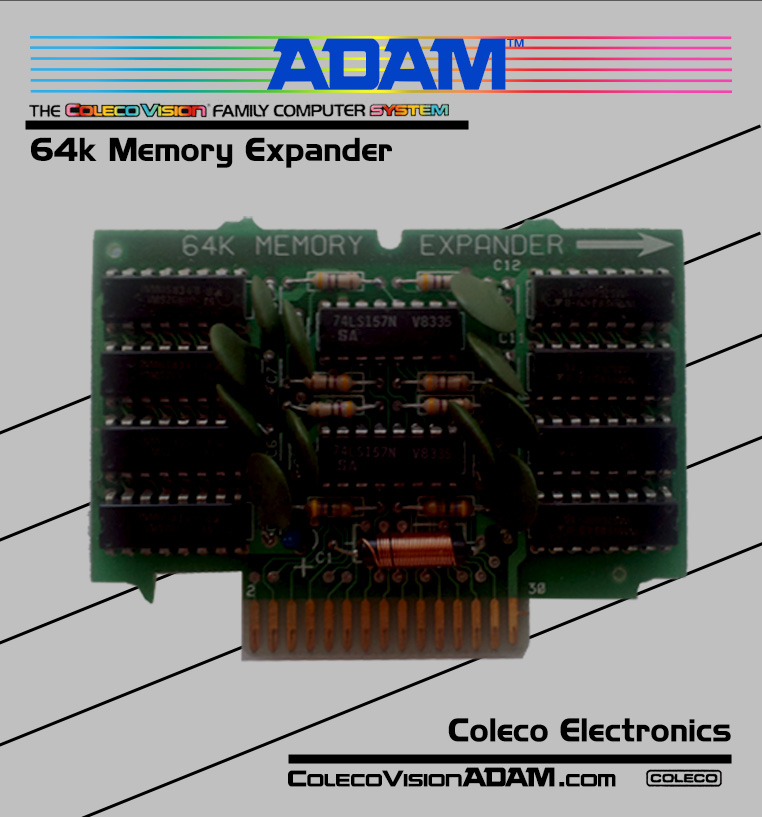
64K Memory Expansion Card Slot #3Coleco's original, first-revision 64K memory card — the same idea as the v2 above on an earlier board layout. It adds 64K of RAM to bring the ADAM from its factory 80K up to a 144K total, enlarging the SmartWriter writing workspace and giving CP/M and SmartBASIC room for a RAM‑disk or print buffer. Like all memory cards it installs in expansion slot #3, the slot dedicated to RAM expansion. Collected
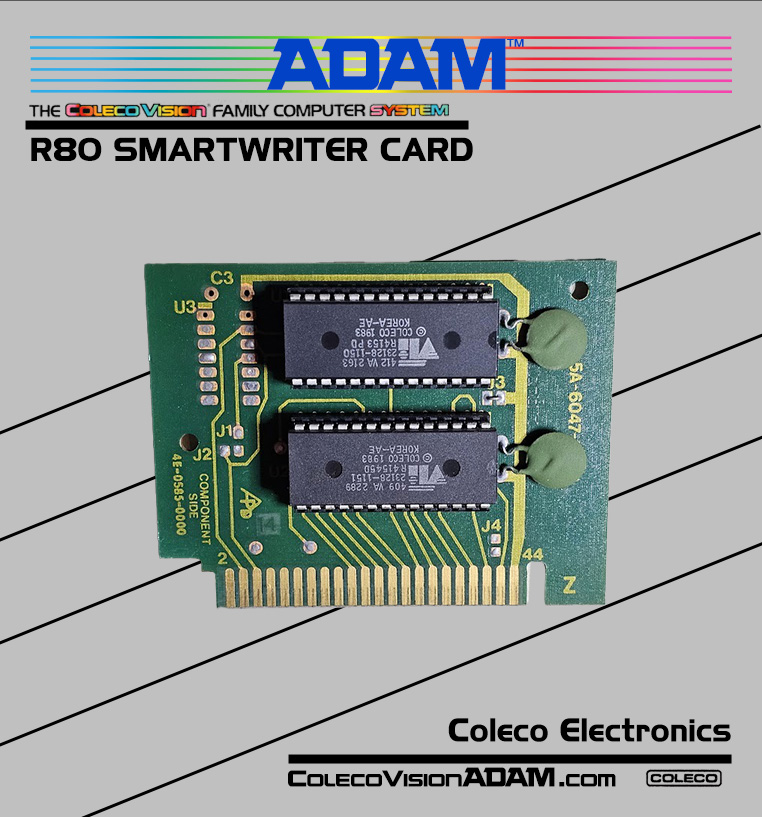
R80 Card Slot #2The ADAM's built-in software — the SmartWriter word processor and the EOS operating system underneath it — lives in ROM/EPROM chips on the motherboard. Coleco revised that software several times over the machine's life (revisions such as R57, R59, R79 and R80) to fix bugs and improve compatibility. Normally, moving an older ADAM up to a newer revision meant opening the console and physically swapping those chips. The R80 Card removes that hassle. Plugged into expansion slot #2, it brings the machine up to SmartWriter Revision 80 without disturbing the motherboard EPROMs — a far easier upgrade for the average owner. Collected
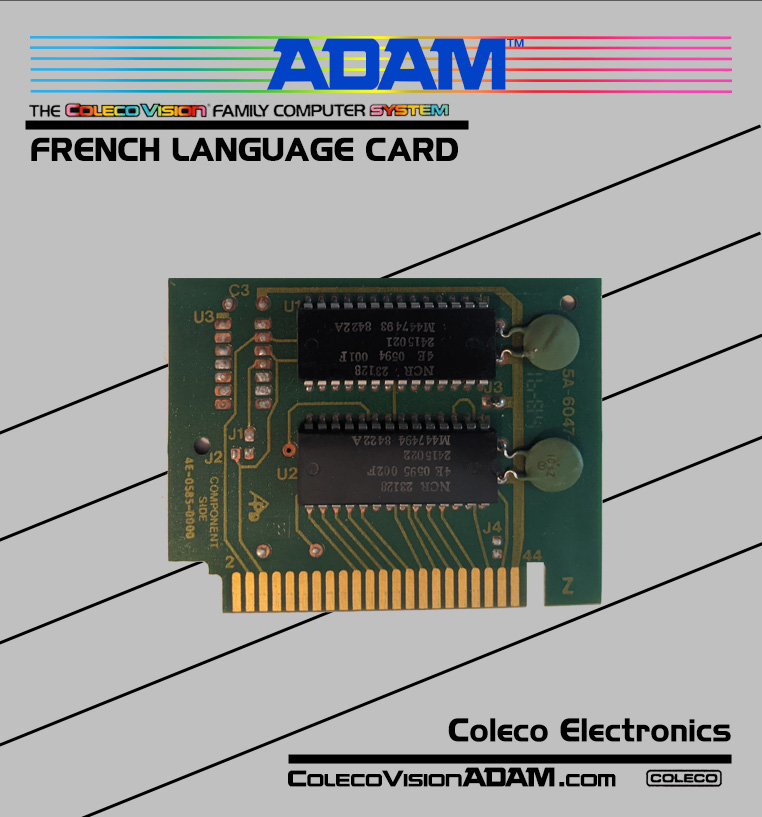
French Language Card Slot #2ADAMs sold in Europe needed a localized word processor. For those markets Coleco offered "language cards" carrying a French or German edition of the SmartWriter ROM, together with the alternate accented-character sets needed to match the matching daisy-wheel print elements (the interchangeable spoked type wheels) used in the ADAM's letter-quality printer. These cards only work in machines built for them: three electrical signals required to reach a language card were never wired up on ADAMs made for the North American market, so the card cannot simply be dropped into a U.S. console. Installs in expansion slot #2. Collected
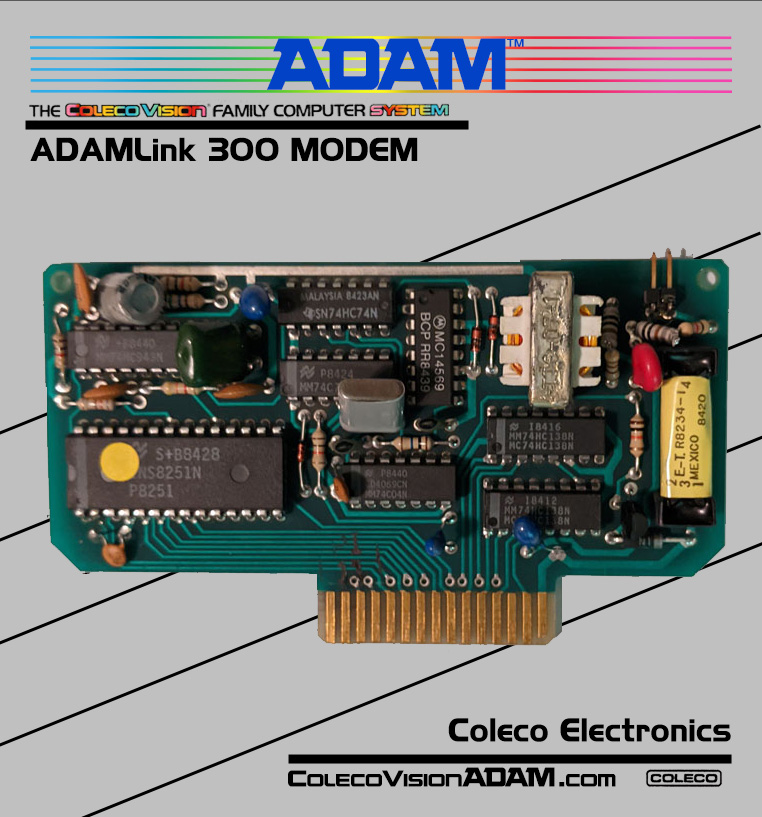
ADAMLink 300 Modem Slot #1A modem let the ADAM talk to other computers over an ordinary telephone line — in the 1980s that meant dialing into bulletin board systems (BBSs) and online services. This Coleco ADAMLink modem is a full-duplex, 300-baud (about 30 characters per second) auto-dial unit that connects straight to the phone line, with no separate interface box or acoustic "receiver cup" coupler required. It follows the Bell 103 standard, so it could communicate with the many other 300-baud modems of the day. The card installs in expansion slot #1 — the slot Coleco reserved for communications — and a special Coleco modem cable routes out through the ventilation slots in the top expansion door to reach the telephone jack. It includes the ADAMLink terminal software used to dial, connect, and transfer files. Collected
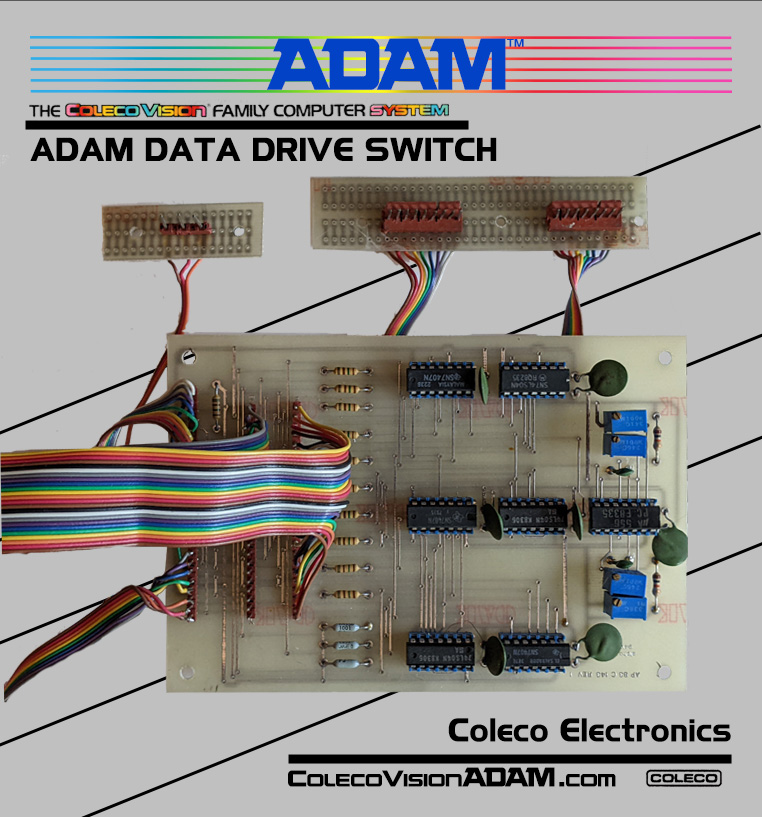
Data Drive SwitchThis is a factory service item rather than a consumer product — a test harness used on the production or repair bench to exercise the ADAM's digital data drive (the cassette-style tape drive) connections. It was never sold at retail, and surviving documentation on it is limited. LUNDY ELECTRONICS
Collected
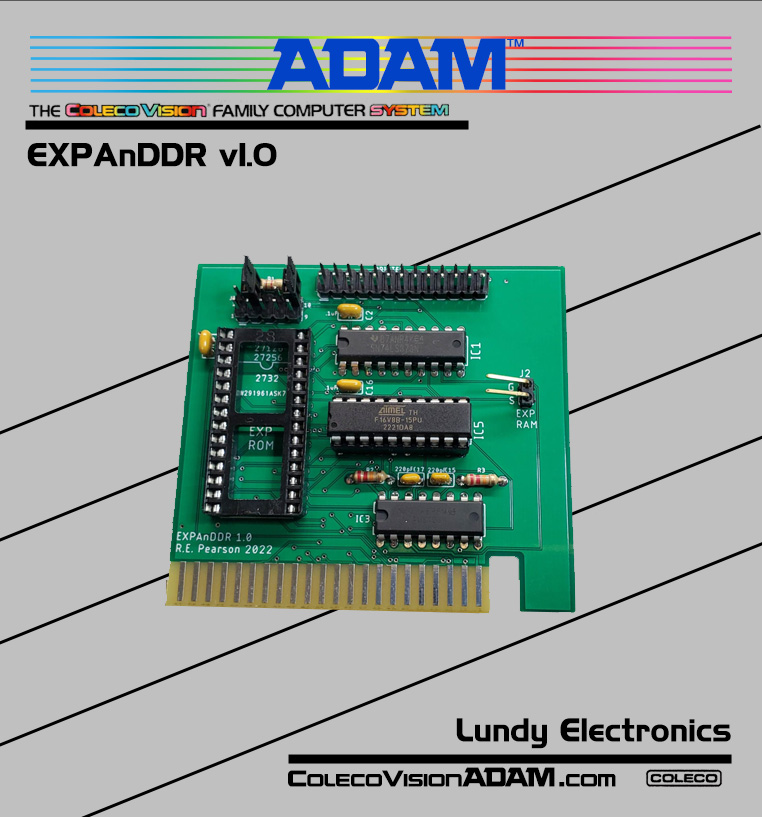
EXPAnDDR Board Slot #2A stripped-down, low-cost interface board that delivers three of the ADAM's most-wanted internal upgrades on one card: a socket for a BOOT PROM (a chip whose start-up code runs the instant the ADAM powers on — useful for booting from a hard drive or loading diagnostics), a Centronics parallel port for standard PC-style printers, and the memory-expander "addressor" signal. That last item matters because the ADAM cannot reach memory cards larger than 64K on its own; a board like this must supply the extra "addressor" signal that lets big 256K–1MB expanders bank-switch their memory into view. The EXPAnDDR is aimed at owners who want to experiment with boot PROMs, diagnose a faulty machine, drive a parallel printer, or simply add an inexpensive addressor. Installs in expansion slot #2. Collected
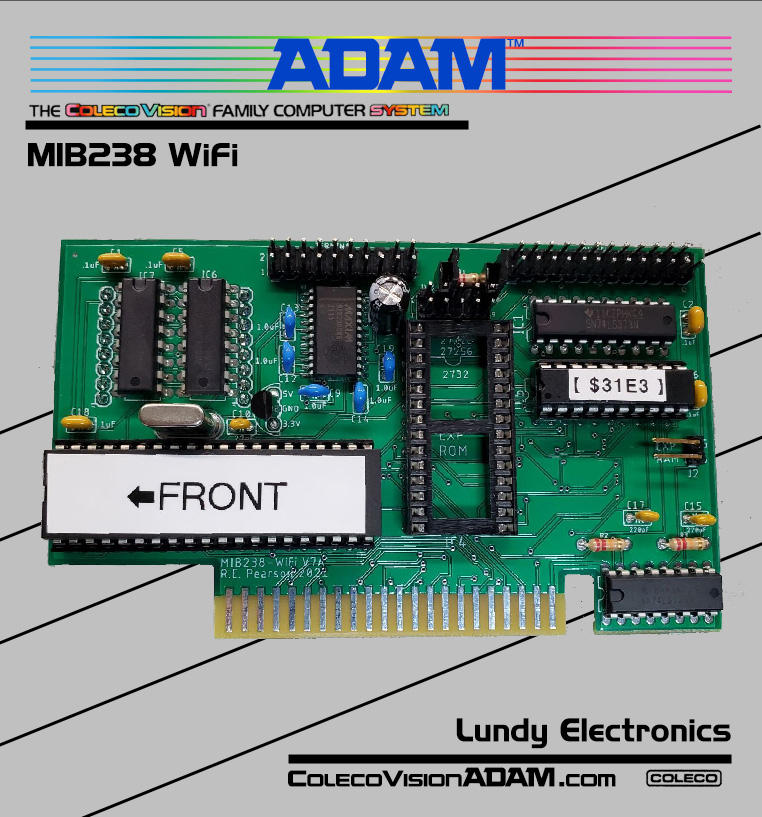
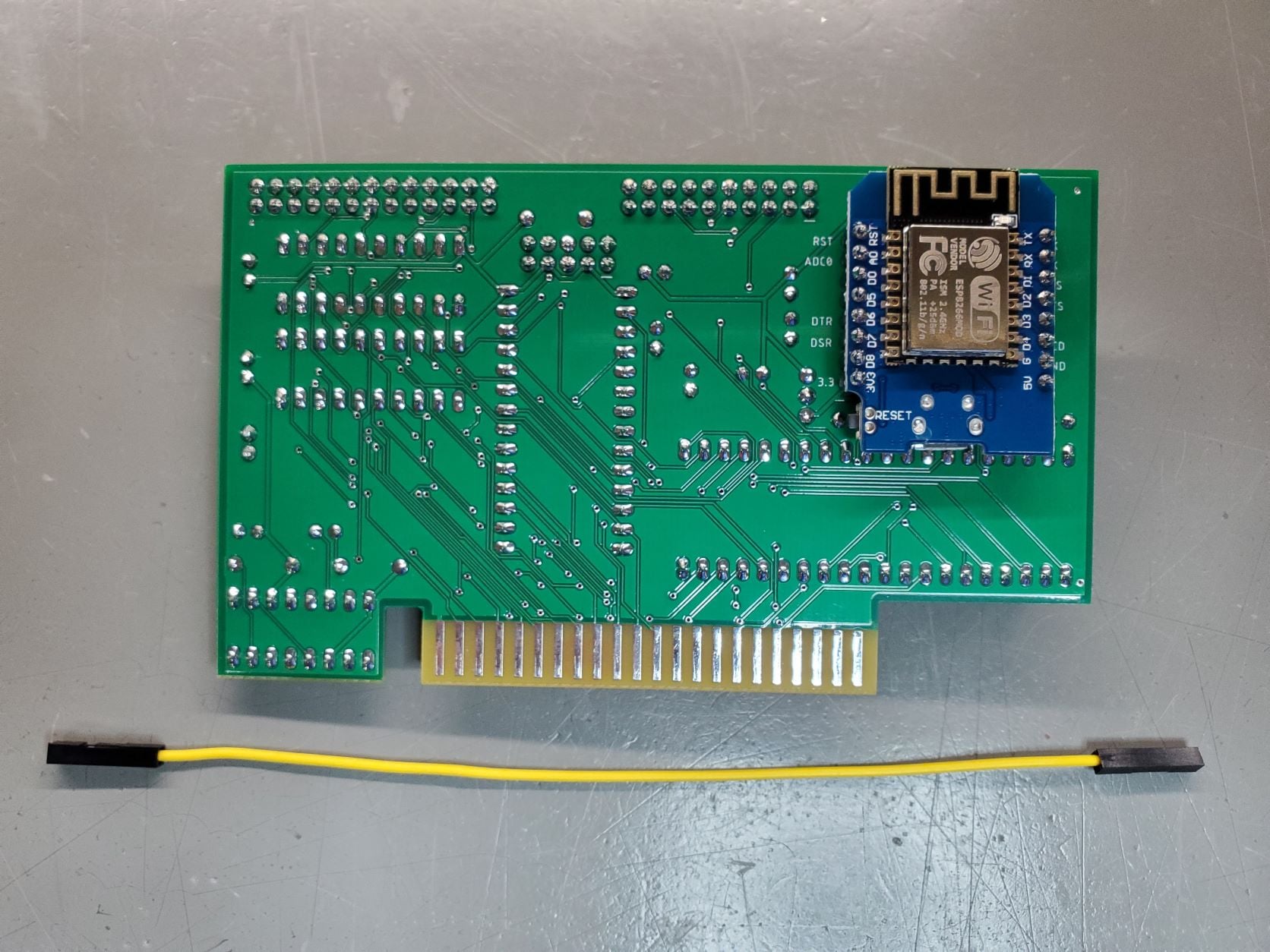
MIB238 WiFi Slot #2The MIB238 is the modern all-in-one interface board for the ADAM, descended from the legendary (and now nearly unfindable) Micro Innovations MIB3. This WiFi version trades the usual external serial port for a built-in WiFi modem — internally a Wemos D1 Mini (ESP8266) running Zimodem firmware — so the ADAM can reach the internet and telnet to BBSs at up to 19.2k baud with no external modem. It carries the rest of the MIB feature set on the same card: a terminal port for adding external 80-column video, a parallel port for a printer, a socket for a boot PROM, and the memory-expander "addressor" signal needed by RAM cards larger than 64K. Installs in expansion slot #2. 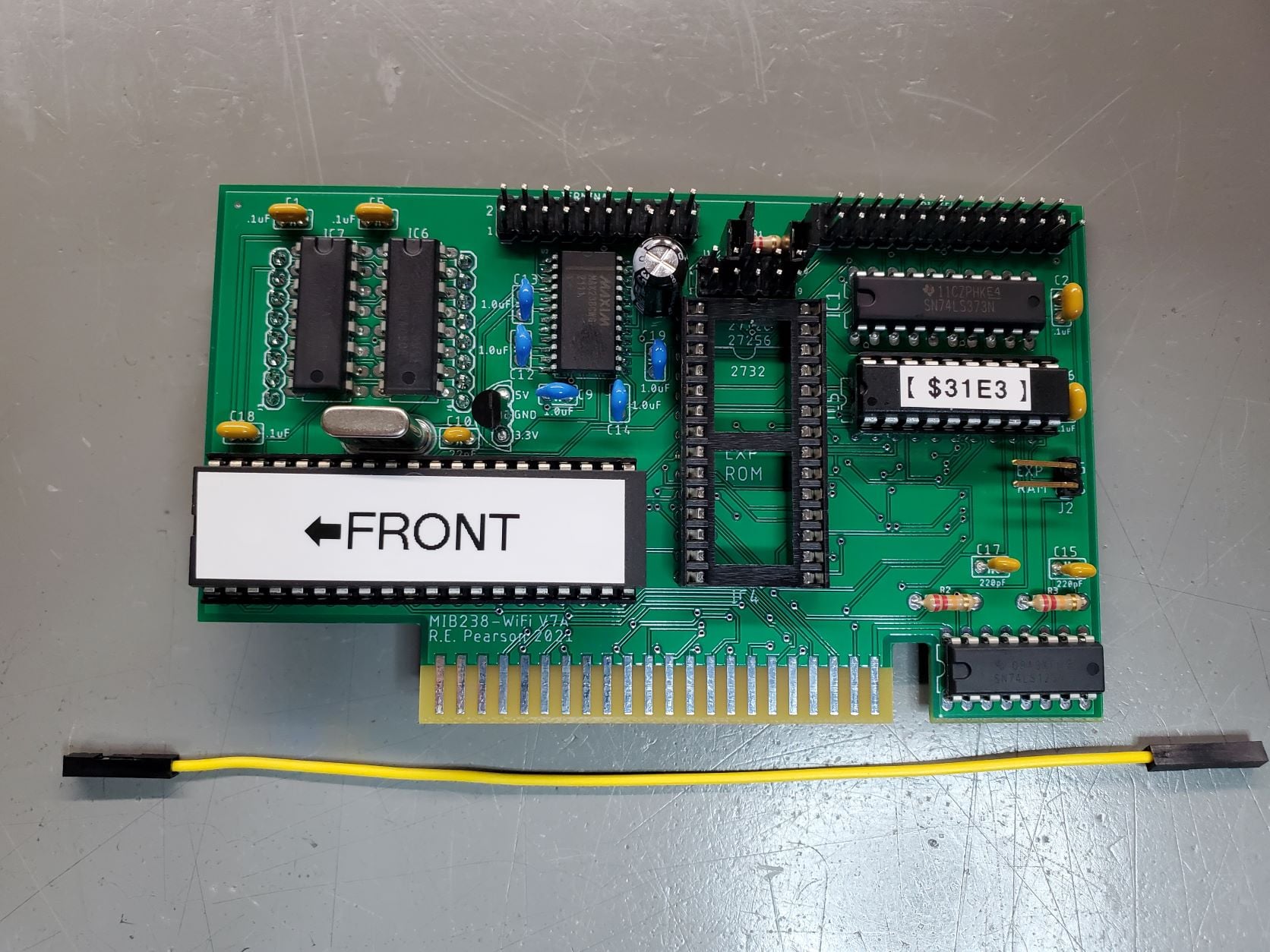
Collected
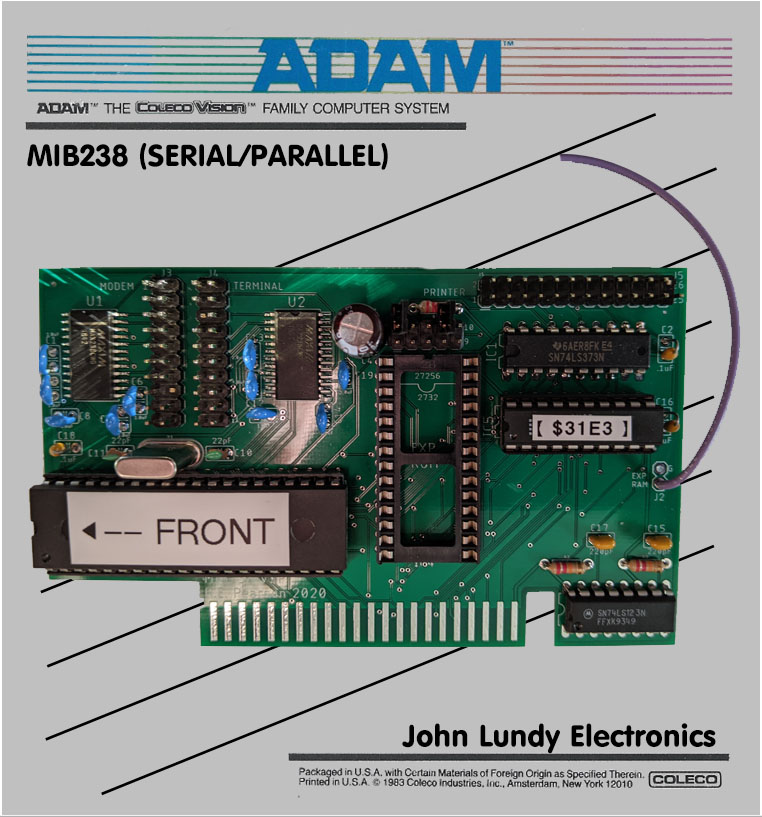
JLE MIB238 Slot #2The Multipurpose Interface Board (MIB238 board) is a redesign of the Micro Innovations MIB3 board that only requires 5 volts using modern MAX238 transceivers. The MIB238, like the MIB3, adds a BOOT PROM socket, two RS-232 ports, a parallel port, and a memory expansion board addressor port to your ADAM computer. Installs in expansion slot #2. Collected
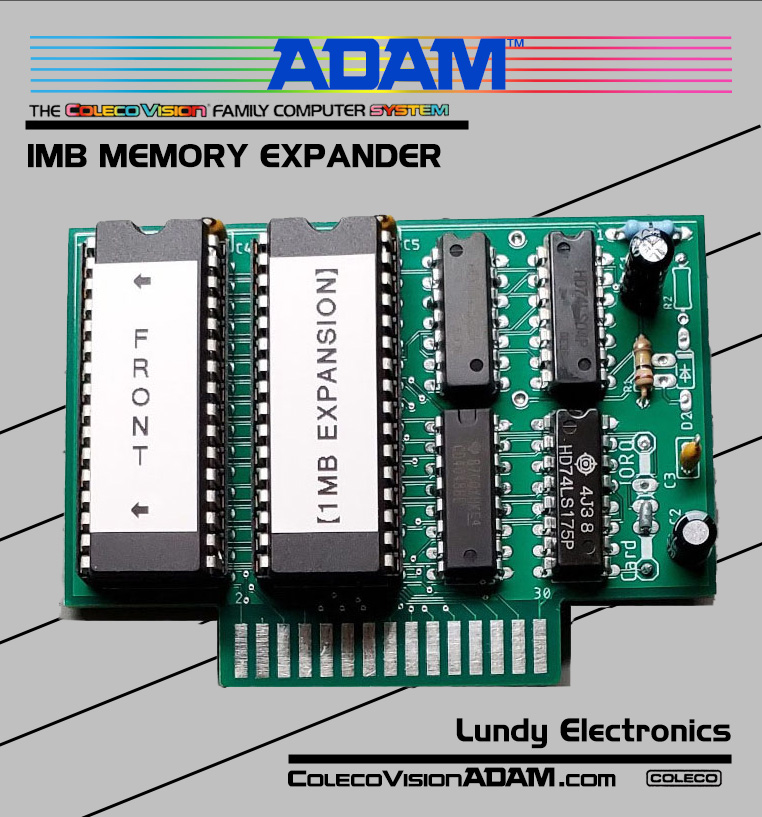
1MB Test Slot #3A 1-megabyte RAM expansion — an enormous amount of memory for the ADAM. Because the machine can't natively address memory beyond its built-in 64K plus one 64K expander, this card requires a companion "addressor" board (such as an MIB3, MIB238, or EXPAnDDR) to supply the extra signal that switches the memory into view. Most native ADAM software won't use memory this large directly, but the CP/M and T-DOS operating systems will turn it into a very fast RAM disk, dramatically speeding up disk-heavy work. Installs in expansion slot #3. Collected
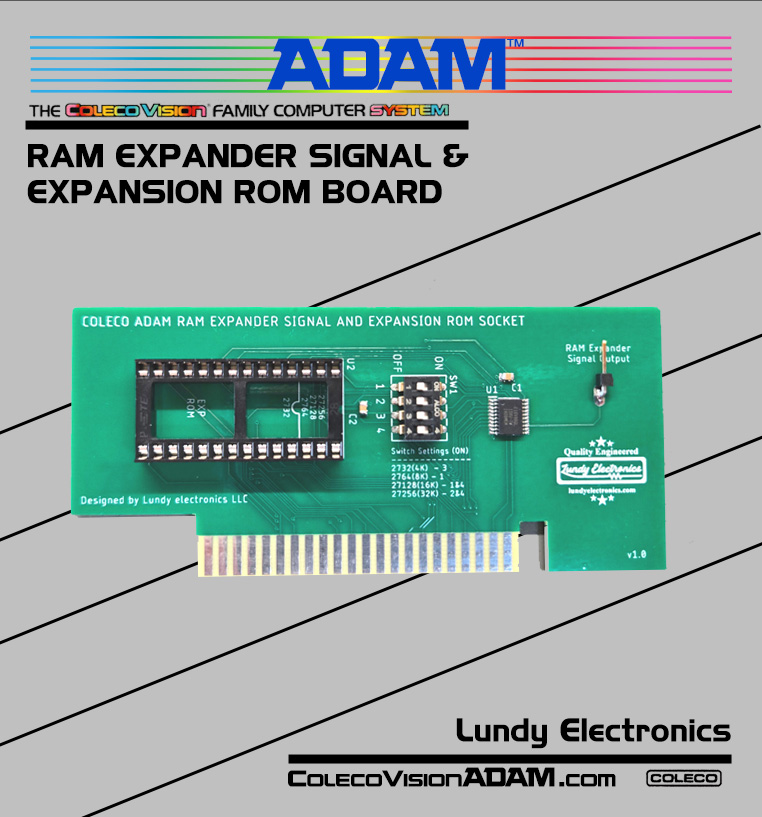
RAM EXPANDER SIGNAL Slot #2A tiny, single-purpose board that solves one specific problem cheaply. The ADAM has no built-in way to reach RAM cards bigger than 64K; large expanders (256K, 512K, 1MB) need an extra "addressor" signal to bank-switch their memory into the processor's view. Rather than buy a full multi-interface board just for that one signal, this Lundy Electronics exclusive generates the required memory-expander addressor signal on its own (and provides an expansion ROM socket as well). Installs in expansion slot #2. Collected
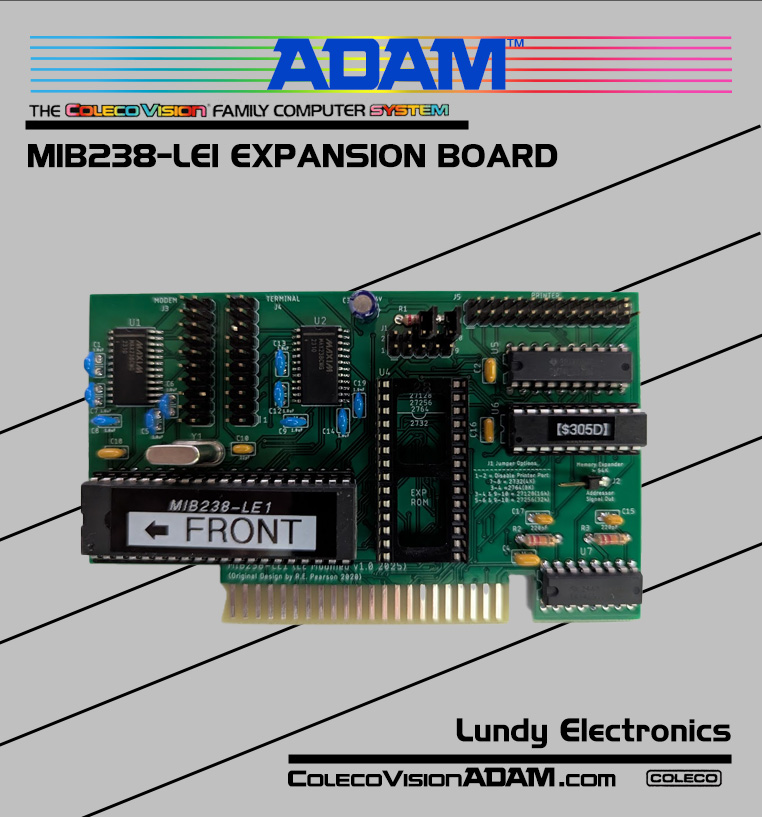
MIB238-LE1 Expansion Board Slot #2A variant of the MIB238 interface board with everything except the built-in WiFi modem. It still provides the board's serial (RS-232), parallel-printer, boot-PROM, and memory-addressor features. It is intended for owners who already have their own modem — whether a vintage physical modem or a modern external WiFi modem such as the popular WiModem232 — and so don't need (or want to pay for) the on-board WiFi. Collected
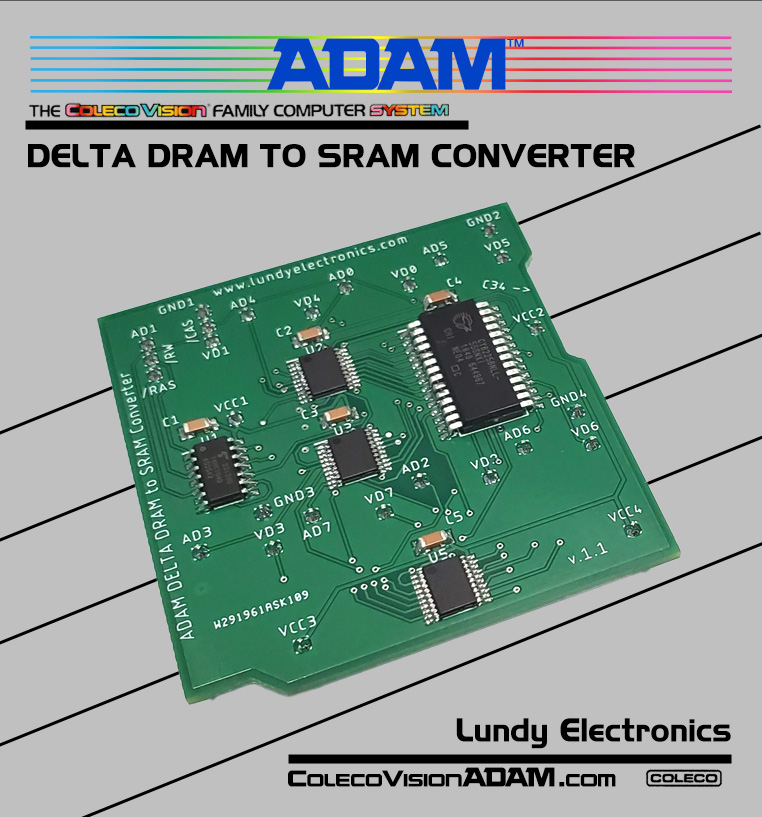
Lundy DRAM to SRAM ConverterA repair and modernization mod rather than an expansion. The ADAM's main memory uses vintage DRAM chips that are now obsolete and increasingly failure-prone, and that also demand the awkward +12V and −5V supply rails of early-1980s memory. This Lundy Electronics PCB mod replaces that DRAM with modern, readily available SRAM. Besides solving the parts-availability problem, it eliminates the need for the inefficient +12V and −5V rails entirely. Collected
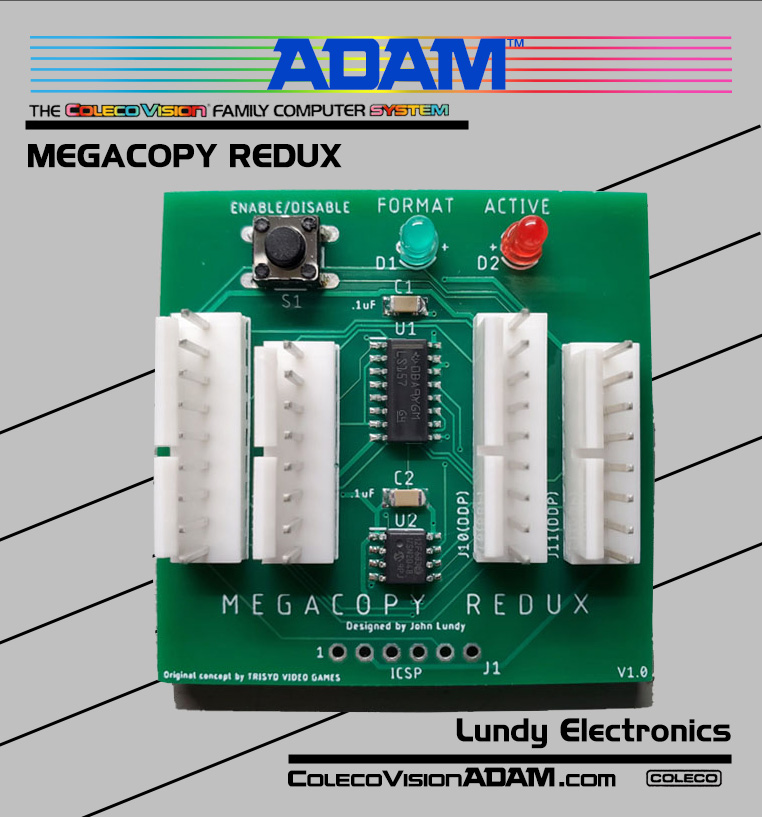
MEGACOPY REDUXWe now have the ability to create new tapes with true digital formatting for the Coleco ADAM! You will no longer have to hunt down and spend a ton of money trying to procure a seemingly impossible to find MEGACOPY III by Trisyd back from 1987. Note: You need two DDP drives in working order to use this device. Collected
.jpg)
1MB Card 2025 Slot #3The Lundy Electronics Coleco ADAM 1MB RAM Expander Board is a Lundy Electronics exclusive design. It uses low-cost, currently-active components from major USA parts suppliers. The design only requires two ICs and passes the saving onto the buyer to make it the lowest cost 1MB RAM expander ever made for the Coleco ADAM. As with any expander larger than 64K, it needs an "addressor" signal from an interface board (MIB3, MIB238, or EXPAnDDR), and is most useful as a fast CP/M or T-DOS RAM disk. .jpg)
Collected
.jpg)
2MB Card 2025 Slot #3The Lundy Electronics Coleco ADAM 2MB RAM Expander Board is a Lundy Electronics exclusive design. It uses low-cost, currently-active components from major USA parts suppliers. The design only requires two ICs and passes the saving onto the buyer to make it the lowest cost 2MB RAM expander ever made for the Coleco ADAM. Like all large expanders it relies on an "addressor" signal from an interface board (MIB3, MIB238, or EXPAnDDR), and the extra memory is typically put to use as a fast CP/M or T-DOS RAM disk. Collected
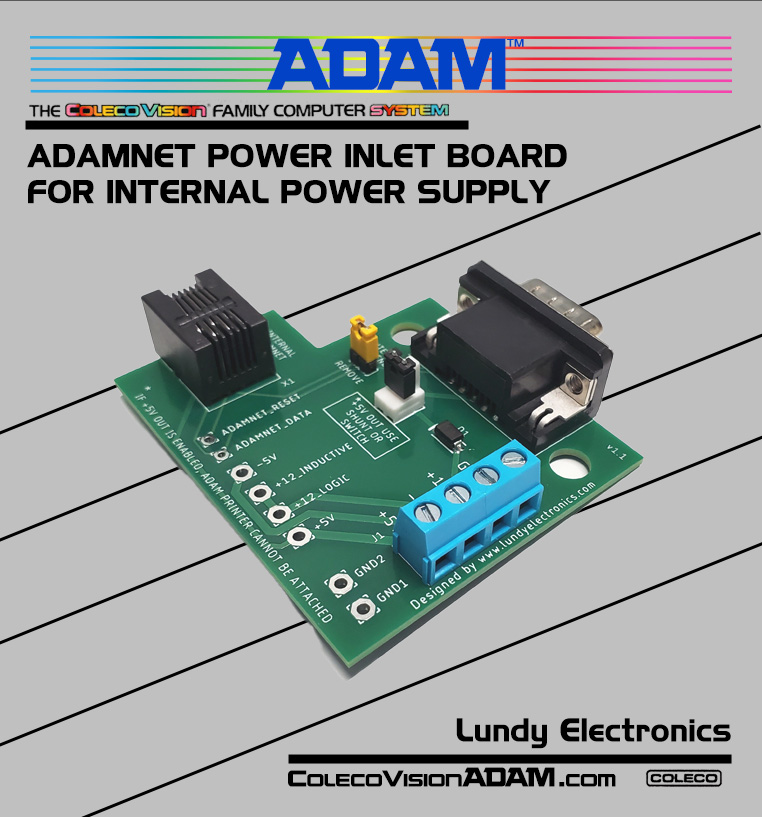
Power Inlet Board (Internal PSU)A board for owners modifying their ADAM to run from an internal power supply. A stock ADAM is unusual in that it draws its power from the bulky external printer, so converting to an internal supply is a popular modern modification — and this Lundy Electronics exclusive provides the internal power inlet and ADAMnet connections (ADAMnet being the ADAM's daisy-chained peripheral bus) that conversion requires. Limit two per customer. Collected
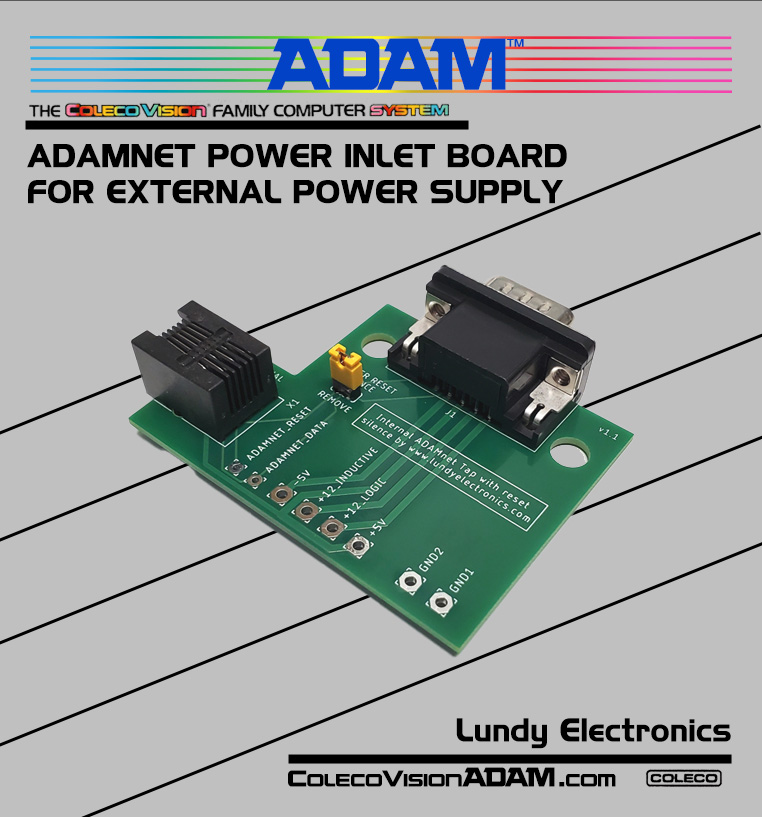
Power Inlet Board (External PSU)The Coleco ADAM ADAMnet Power Inlet Board for External Power Supply Adapter is a Lundy Electronics exclusive that offers a seamless way to add an internal ADAMnet connector and a printer reset silencer while using a factory printer power supply. Limit two per customer. MICRO INNOVATIONS
Collected
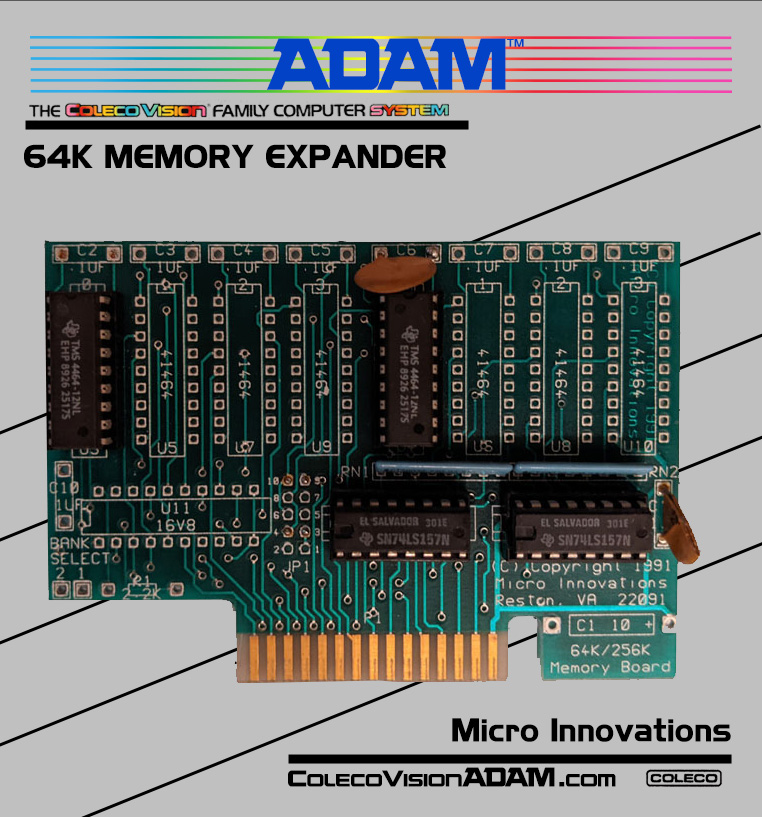
MI 64k V2 Slot #3Micro Innovations — based in Reston, Virginia, and the leading third-party hardware maker for the ADAM — offered its own 64K memory card. Like Coleco's, it adds 64K of RAM to bring the system to 144K total, enlarging the SmartWriter writing workspace and giving the CP/M and SmartBASIC environments room for a RAM disk. Installs in expansion slot #3. Collected
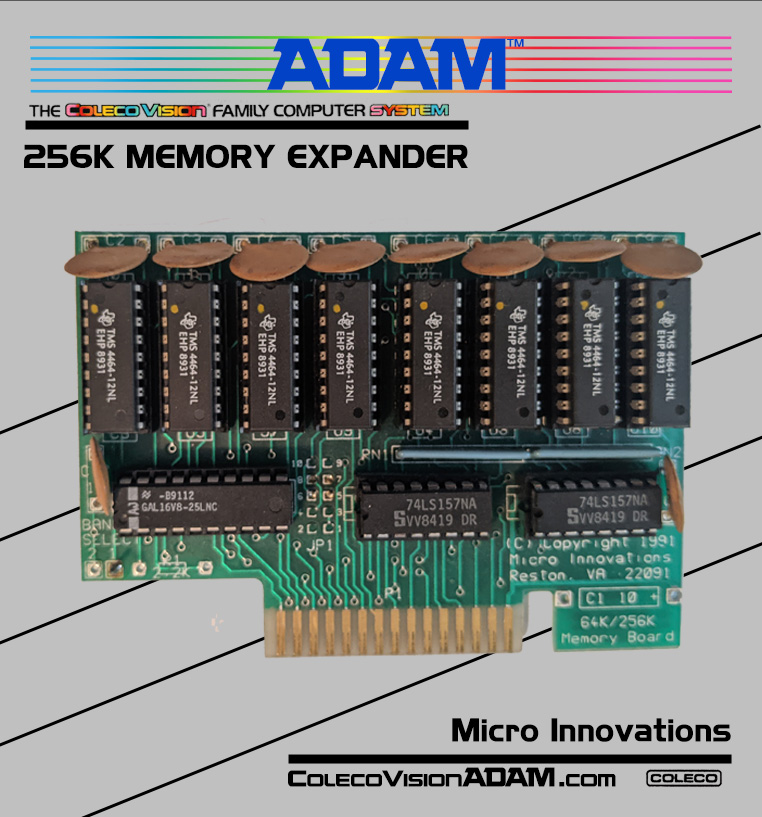
MI 256K Slot #3A larger Micro Innovations memory card that adds 256K of RAM, bringing the ADAM to roughly 320K total. Because this far exceeds the 64K the machine can address on its own, it needs an "addressor" signal from an interface board (such as an MIB3); CP/M and T-DOS then put the extra space to work as a large, fast RAM disk. Installs in expansion slot #3. Collected
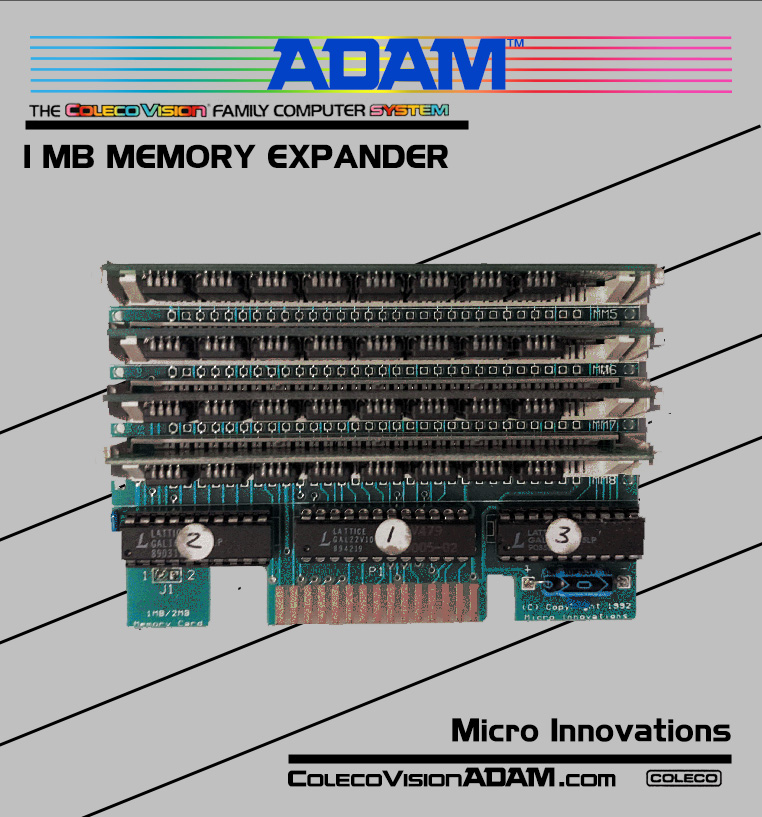
MI 1MB Slot #3Micro Innovations' top-end memory card, adding a full megabyte of RAM for a system total of about 1088K. As with any expander beyond 64K it requires an "addressor" signal from an interface board, and is most useful as a fast CP/M or T-DOS RAM disk. Note that some programs cap how much they will use — PowerPaint, for example, accesses only up to 512K. Installs in expansion slot #3. Collected
.jpg)
MI 1MB V2.0 (REVERSE SIM) Slot #3The second revision of Micro Innovations' 1MB card, distinguished by its reverse SIM-mounting layout. Functionally it matches the 1MB card above: a full megabyte of RAM (about 1088K system total) that requires an "addressor" signal from an interface board and is best used as a fast CP/M or T-DOS RAM disk. Some programs cap their use — PowerPaint, for instance, accesses only up to 512K. Installs in expansion slot #3. .jpg)
Collected
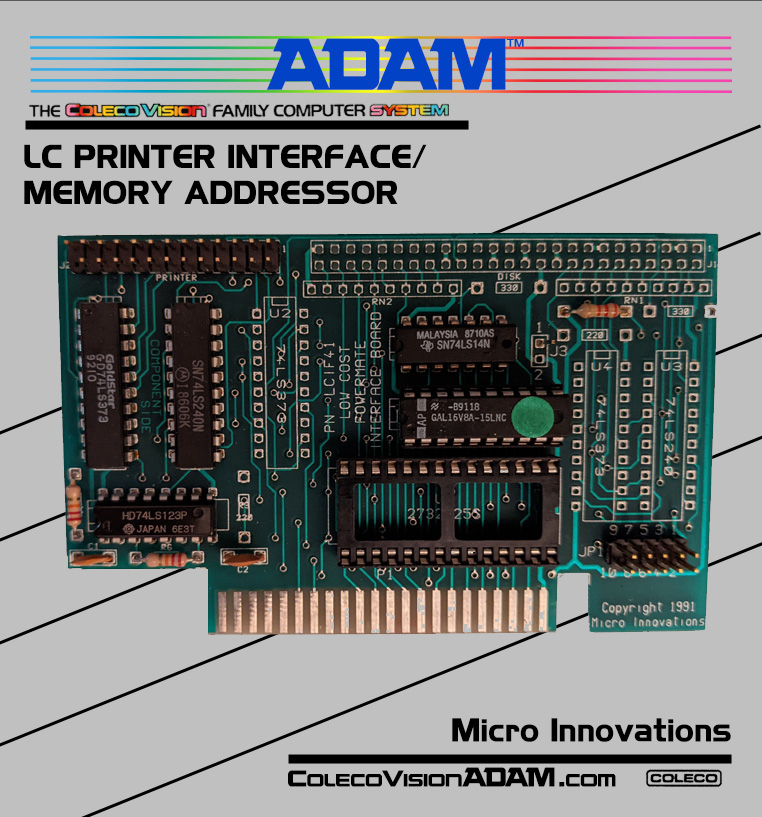
MI LC Interface Slot #2The "LC" interface board covers two of the ADAM's most common needs at once: it drives a wide range of parallel (Centronics) printers, and it supplies the "addressor" signal that gives access to memory beyond the base 64K. It can also hold a boot EPROM to load software automatically at reset. Installs in expansion slot #2. Collected
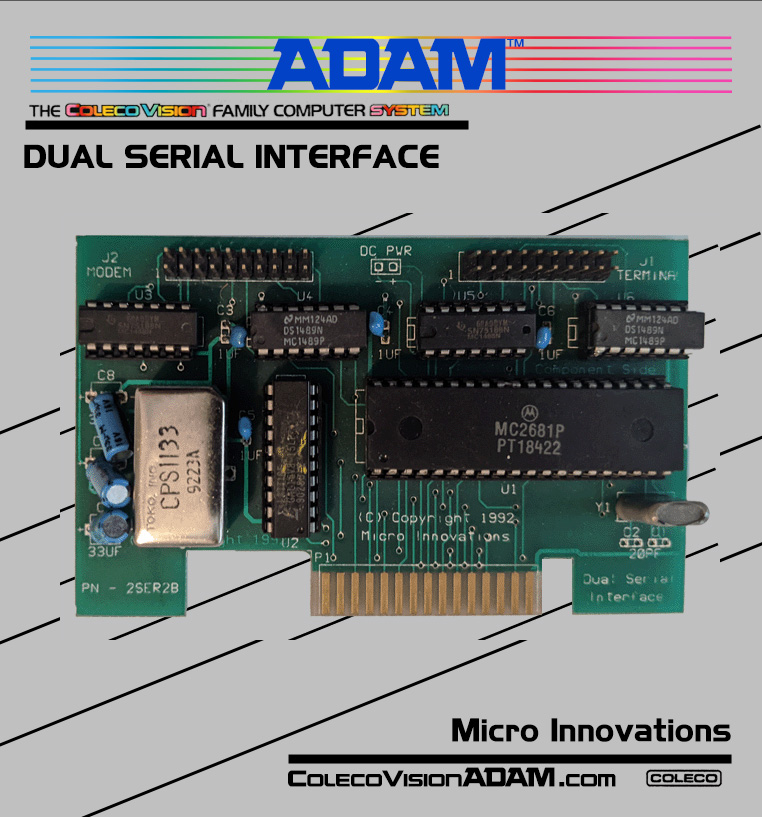
MI Dual Serial Slot #1Plug-in board for Coleco ADAM Computer that provides two RS-232 serial ports • one set-up for a CRT terminal or serial printer and the other set up for a modem. Installs in expansion slot #1. Collected
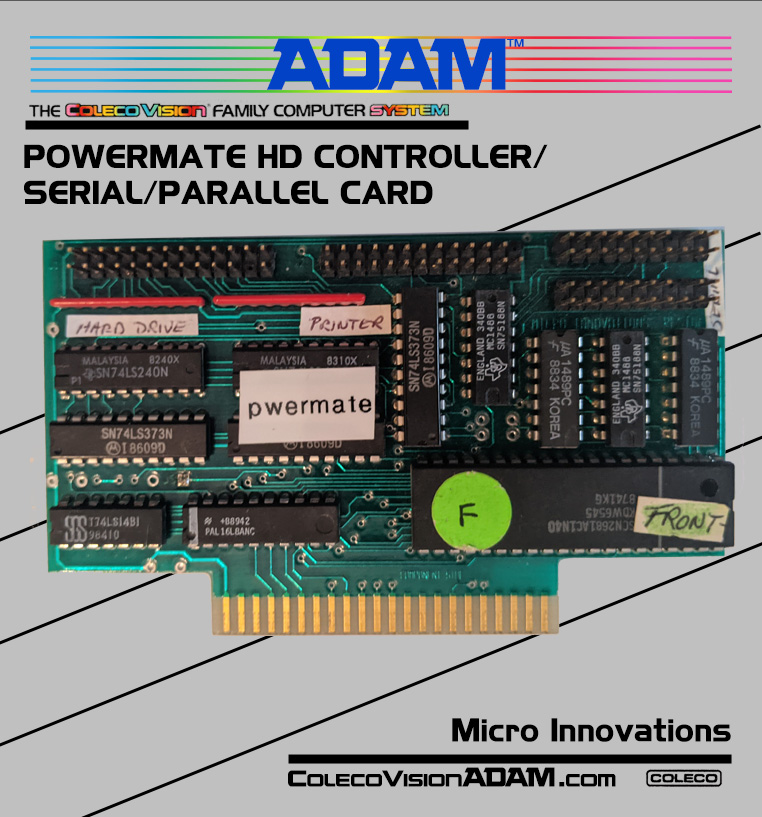
MI HD/Parallel/Serial Slot #2A combination interface card that bundles three functions on one board: a hard-disk (Powermate) host connection, a Centronics parallel printer port, and an RS-232 serial port. It is the all-in-one companion card for a Micro Innovations Powermate hard-drive system, sparing the owner from stacking several separate cards. Installs in expansion slot #2. Collected
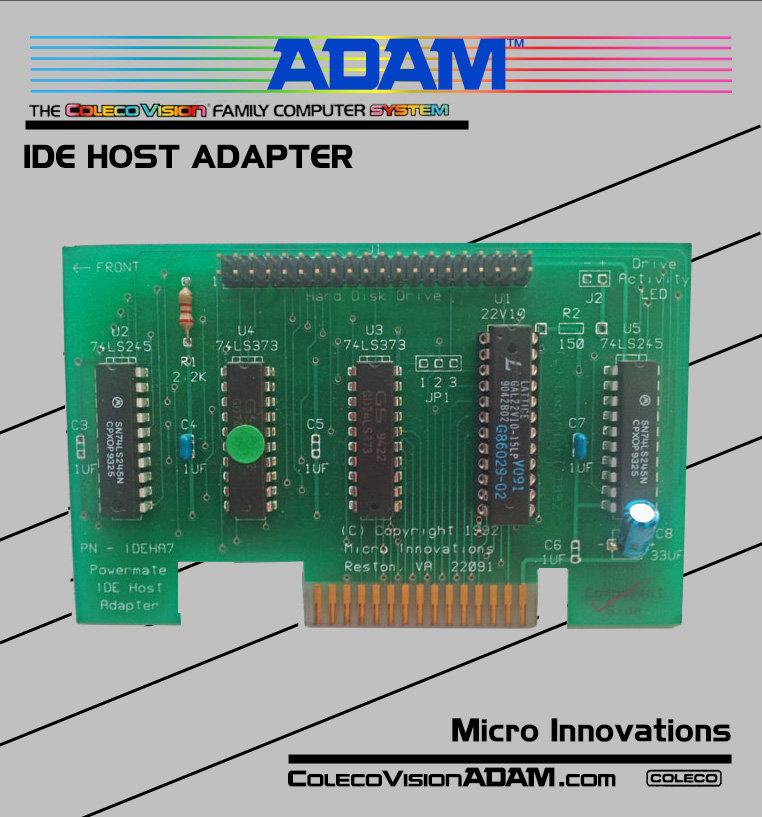
MI Powermate Host Slot #1The Powermate was Micro Innovations' hard-drive subsystem for the ADAM — an external unit (offered in 10MB and 20MB sizes) designed by Mark Gordon that added genuine hard-disk storage without cutting into or modifying the console. This is the host-adapter card that plugs into the ADAM and links to the Powermate drive over an IDE cable. Installs in expansion slot #1. 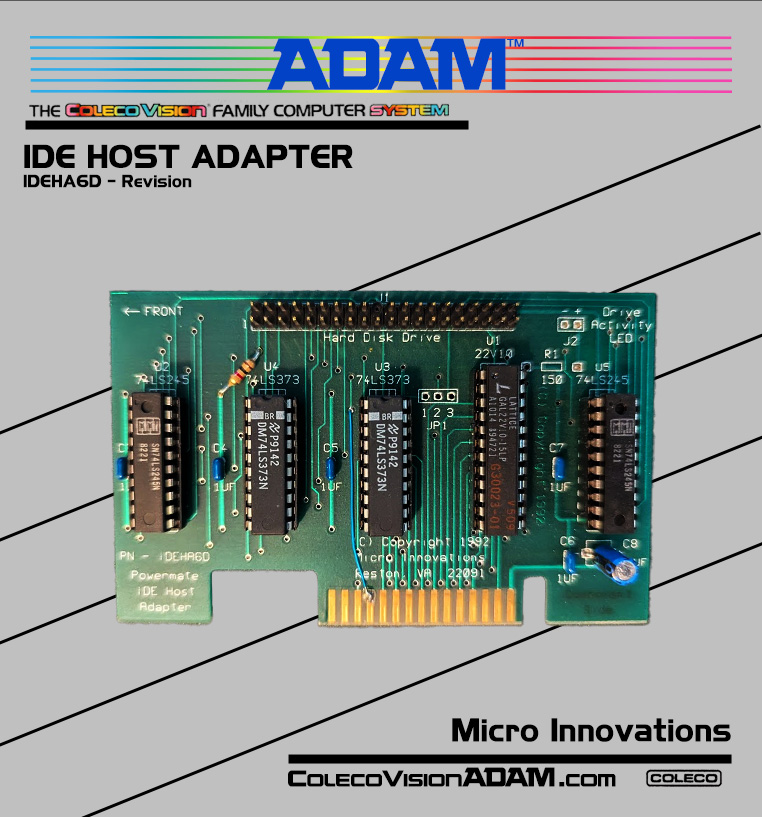
Collected
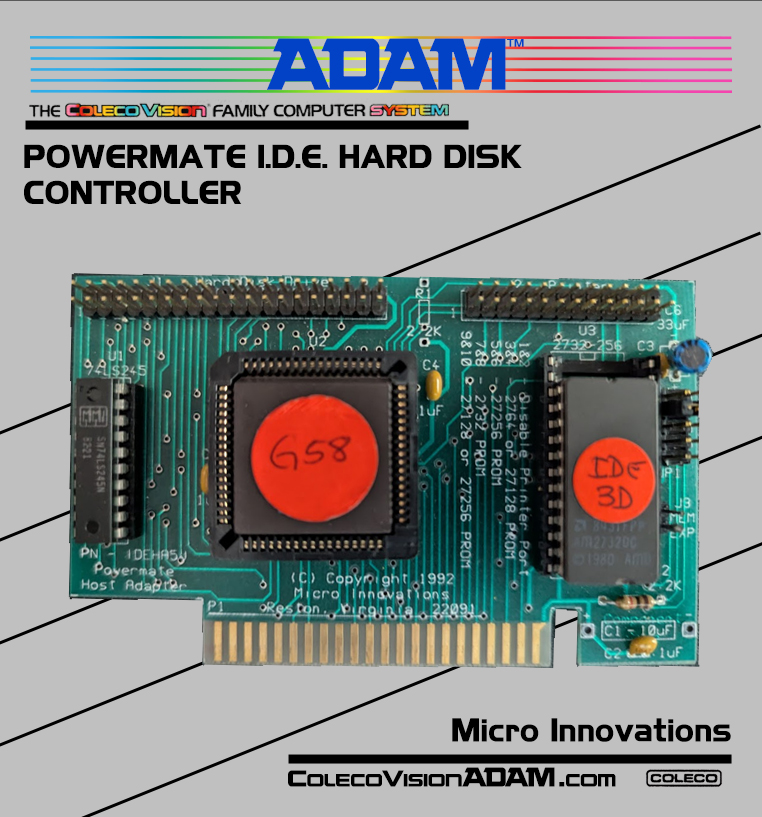
MI Powermate HD IDE Card w/ Boot EPROM Slot #2A very rare variant of the Powermate IDE host adapter that also carries a boot EPROM, allowing the ADAM to start up directly from the hard drive at power-on instead of from tape or disk. Installs in expansion slot #2. Collected
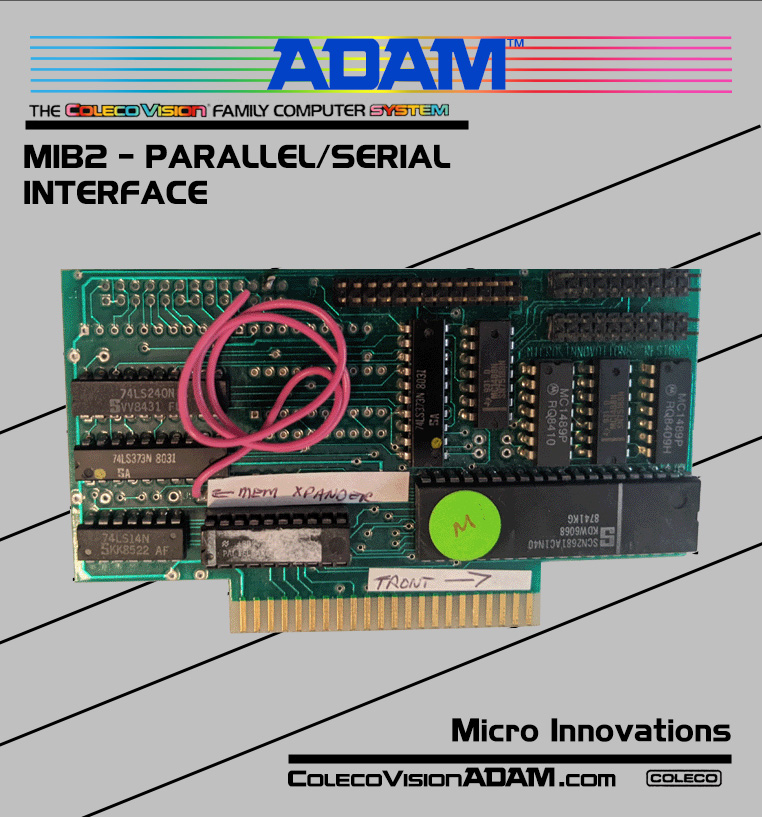
MI MIB2 Slot #2Micro Innovations' Multi-Interface Board, version 2 — an earlier step on the way to the famous MIB3, gathering several of the ADAM's add-on functions (serial and parallel I/O plus memory support) onto a single card. Installs in expansion slot #2. Collected
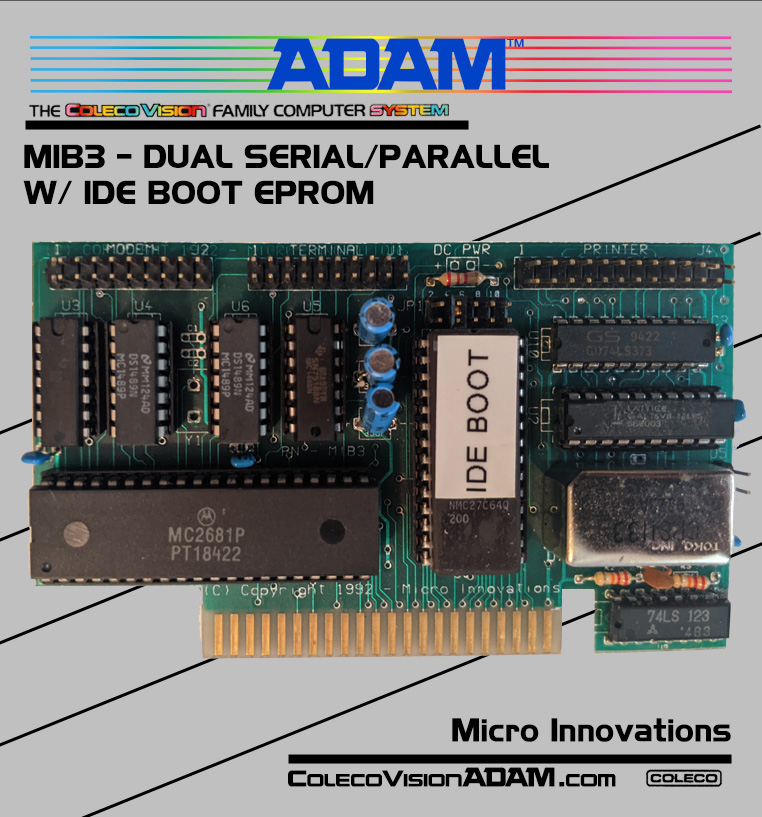
MIB3 Slot #2The Micro Innovations Multi-Interface Board version 3 — the single most influential ADAM interface card. On one board it provides a boot-PROM socket, two RS-232 serial ports, a Centronics parallel printer port, and the memory-expander "addressor" signal that RAM cards over 64K depend on. Original MIB3 boards are now extremely difficult to find, which is precisely why modern recreations such as the MIB238 (including the Lundy and Brewing Academy versions elsewhere on this page) were created to take its place. Installs in expansion slot #2. 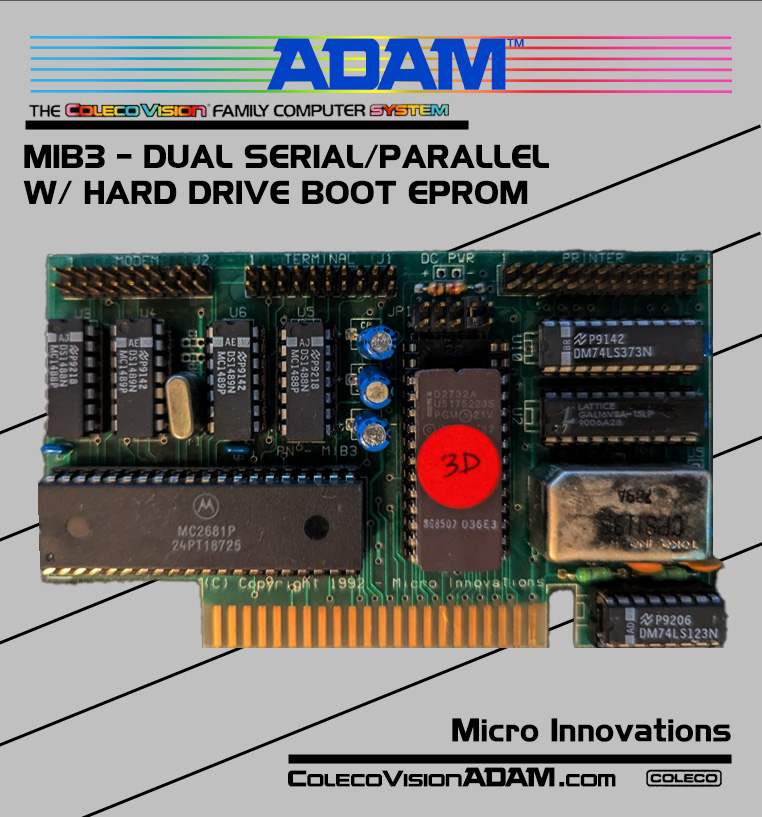
Collected
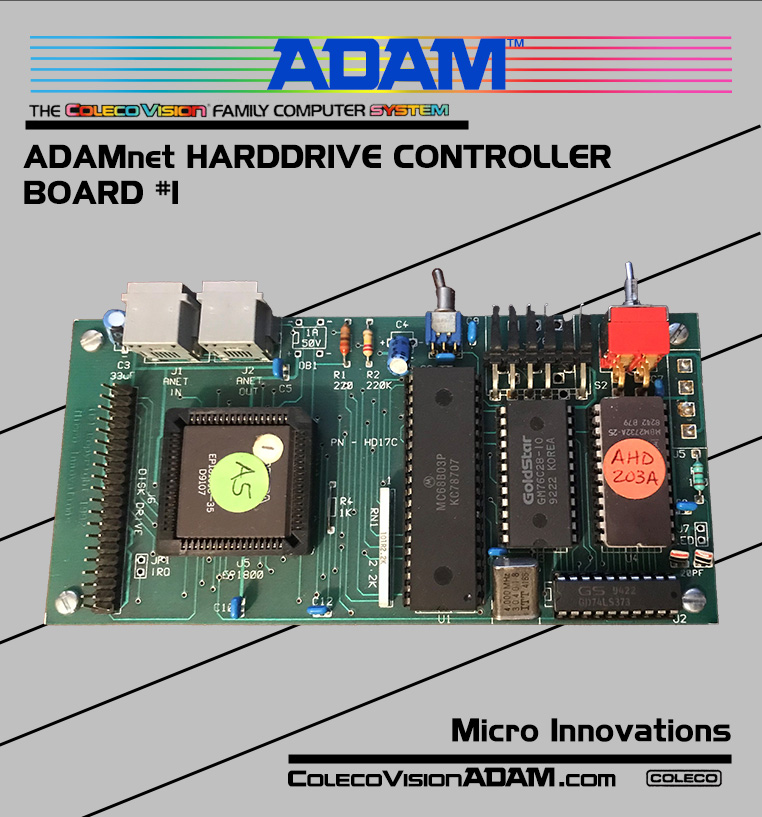
MI ADAMnet HD Controller Slot #2A rare controller that connects a hard drive directly to ADAMnet — the ADAM's own daisy-chained peripheral bus that ties together its tape drives, keyboard and printer — rather than through a slot-based host adapter. By speaking the ADAM's native peripheral language, it let a hard disk behave like a built-in ADAM device. 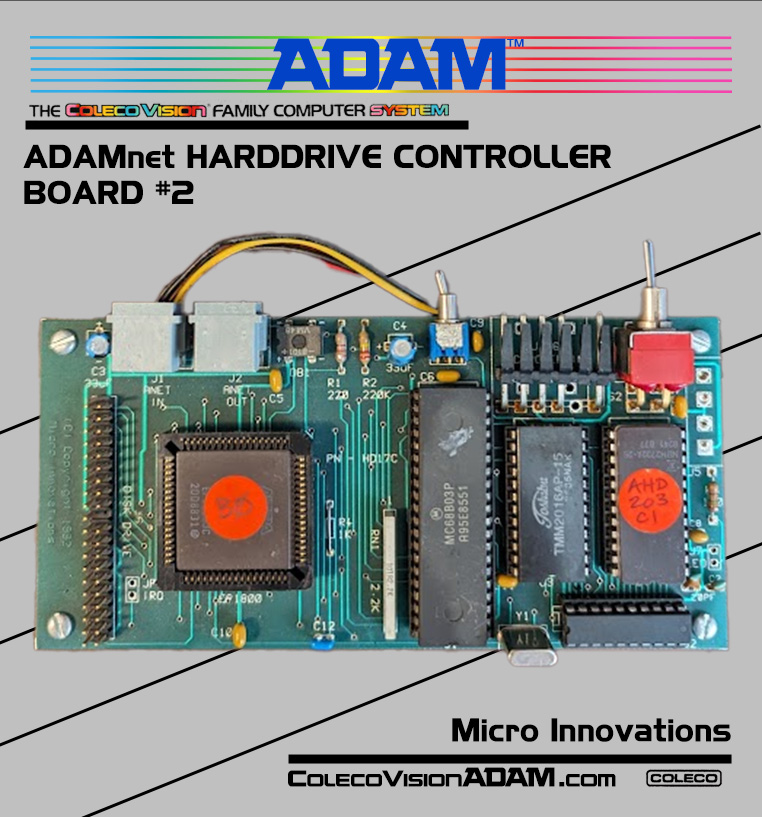
Collected
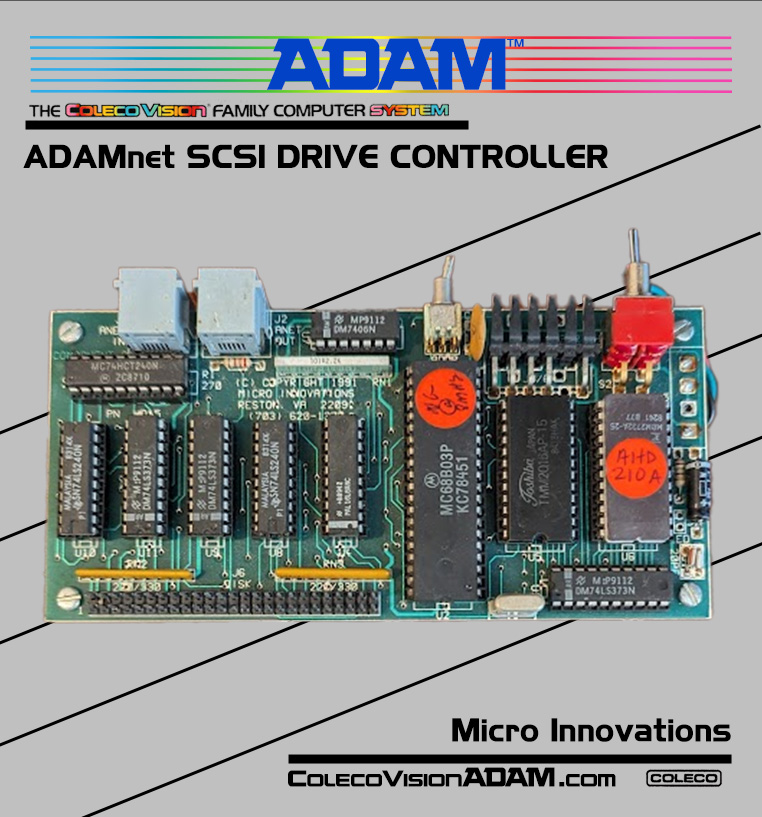
MI SASI ControllerA controller card for attaching SASI hard drives to the ADAM. SASI (Shugart Associates System Interface) was the early-1980s forerunner of SCSI — a common way to connect hard disks before IDE became the norm — and this board bridges the ADAM to SASI storage. 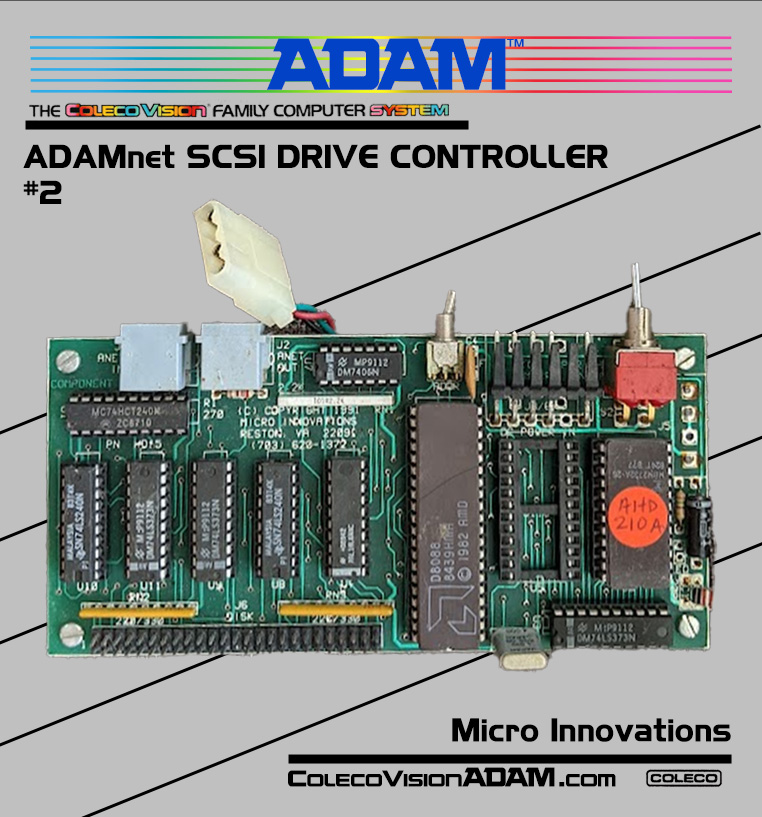
.jpg)
.jpg)
Collected
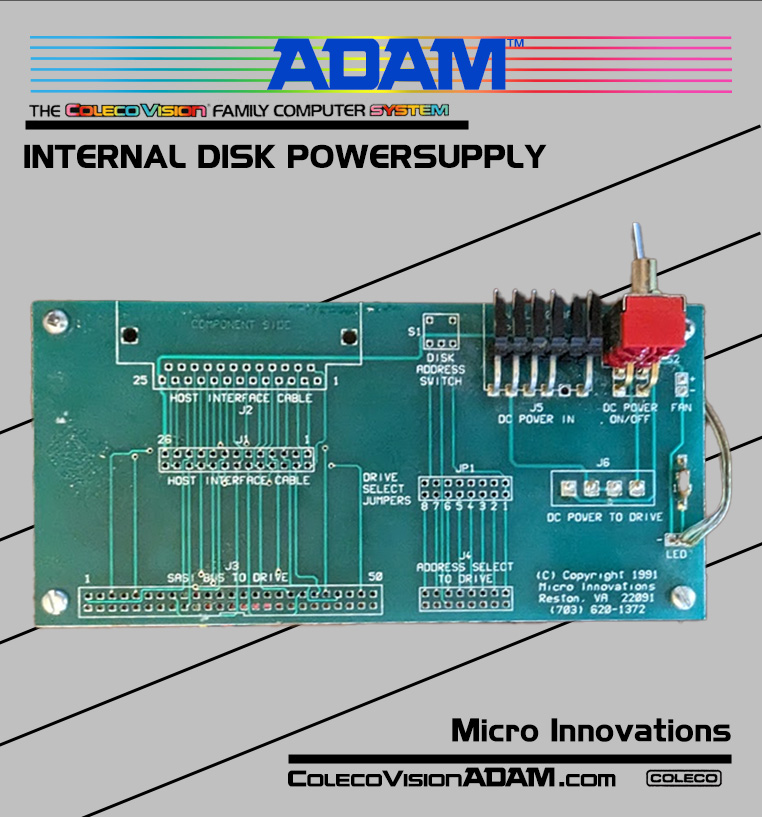
MI Disk PowerA power-distribution board that supplies and routes the various voltages a Micro Innovations disk- or hard-drive subsystem needs, keeping the power wiring tidy and reliable inside a drive enclosure. Collected
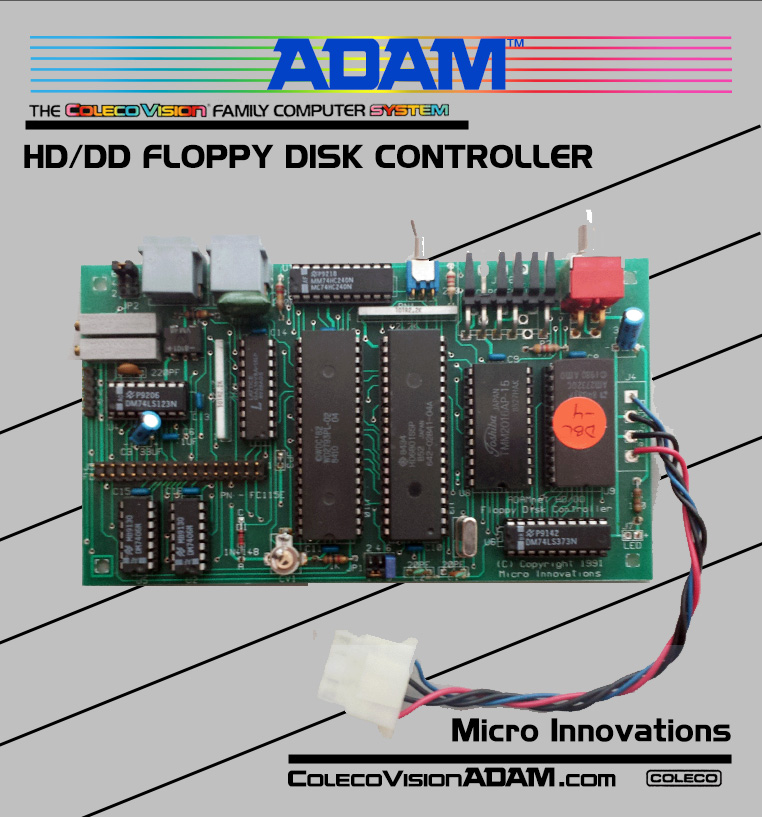
MI Adamnet HD/DD Floppy DiskAn ADAMnet interface that lets standard double-density (DD) and high-density (HD) floppy disk drives connect to the ADAM, presenting them to the system over its native ADAMnet peripheral bus — a big capacity and convenience step up from the ADAM's original tape (digital data pack) storage. Collected
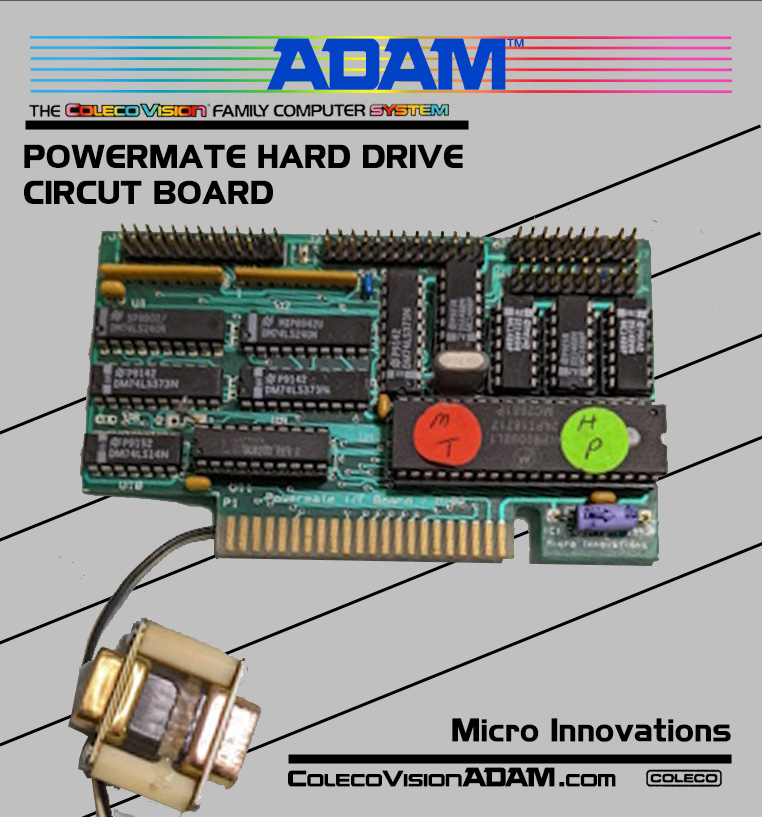
MI Powermate Circuit Board Slot #2The interface circuit board from within a Micro Innovations Powermate hard-drive subsystem — the electronics that manage the drive and bridge it to the ADAM host adapter. Installs in expansion slot #2. Collected
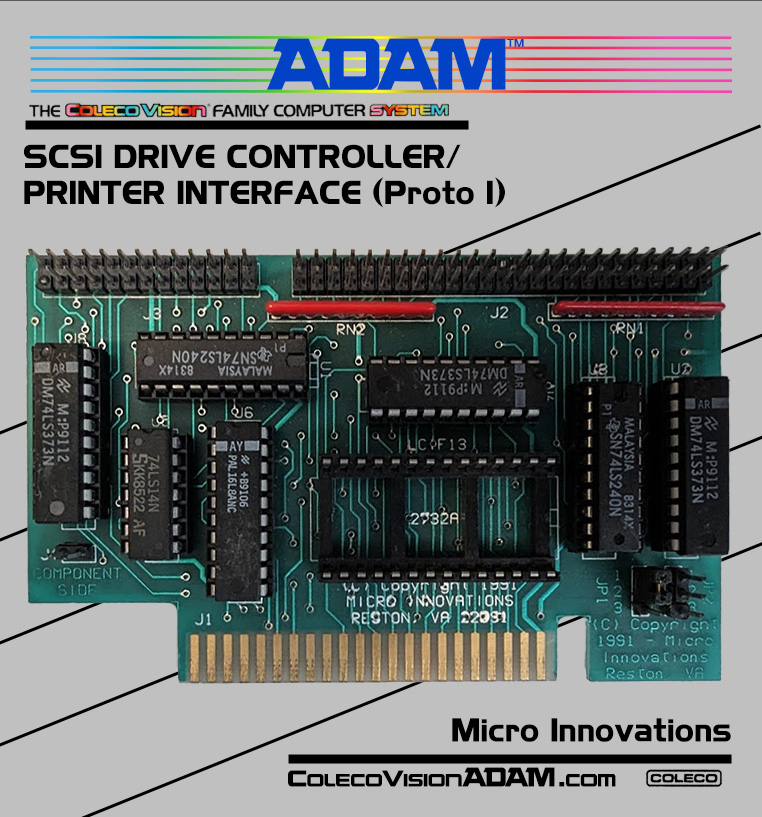
MI SASI PI CardsSASI Peripheral Interface cards used within the Powermate / hard-drive subsystem to connect SASI storage devices. SASI (Shugart Associates System Interface) was the predecessor to SCSI, a standard for attaching hard disks in the early 1980s. 

MICROFOX TECHNOLOGIES
Collected
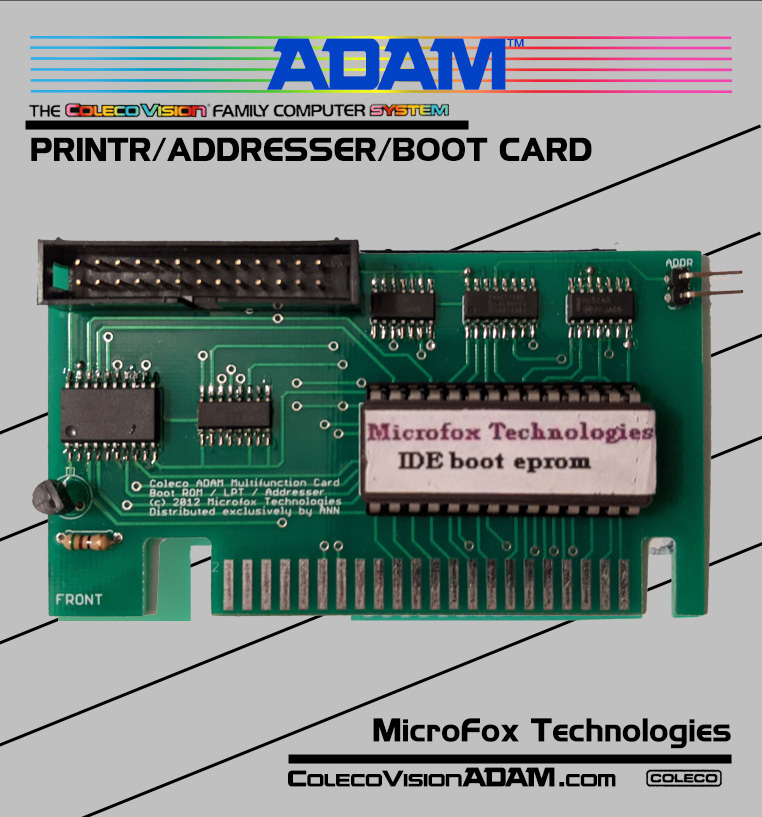
MF IDE Interface Slot #2MicroFox Technologies' IDE interface for the ADAM. It lets standard IDE/PATA hard drives — or modern solid-state IDE-to-CompactFlash and IDE-to-SD adapters — be used as fast, high-capacity ADAM hard-disk storage in place of the original tape drives. Installs in expansion slot #2. Collected
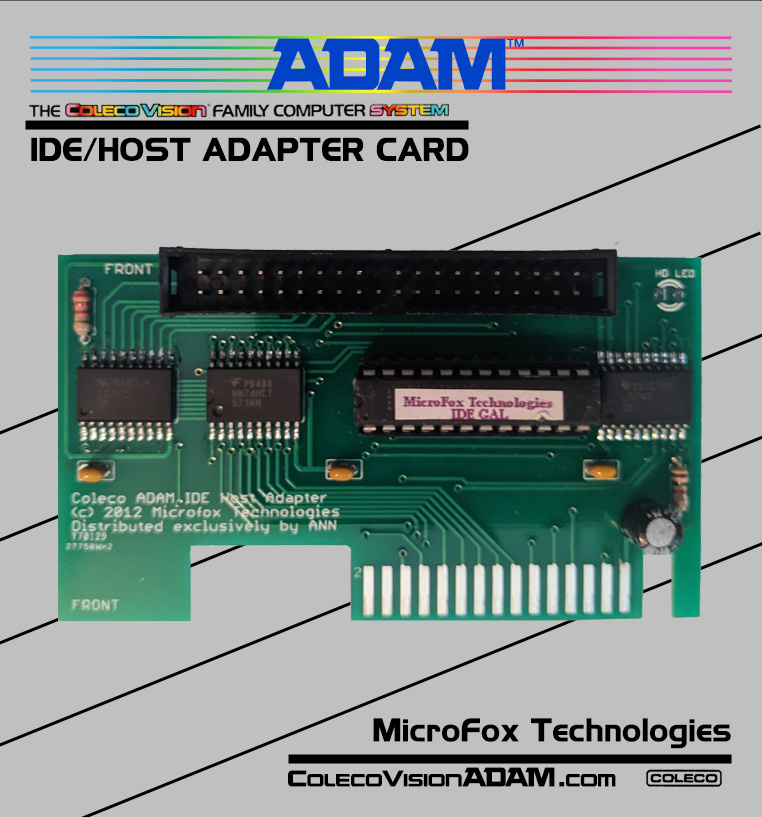
MF IDE Host Adaptor Slot #1The host-adapter half of MicroFox's IDE storage system (© 2012 MicroFox Technologies, distributed exclusively by ANN). It seats in expansion slot #1 and connects by a 40-pin ribbon cable to an IDE drive or solid-state CF/SD adapter — see the "IDE Card with SD Storage" entry below for the complete setup. Installs in expansion slot #1. Collected
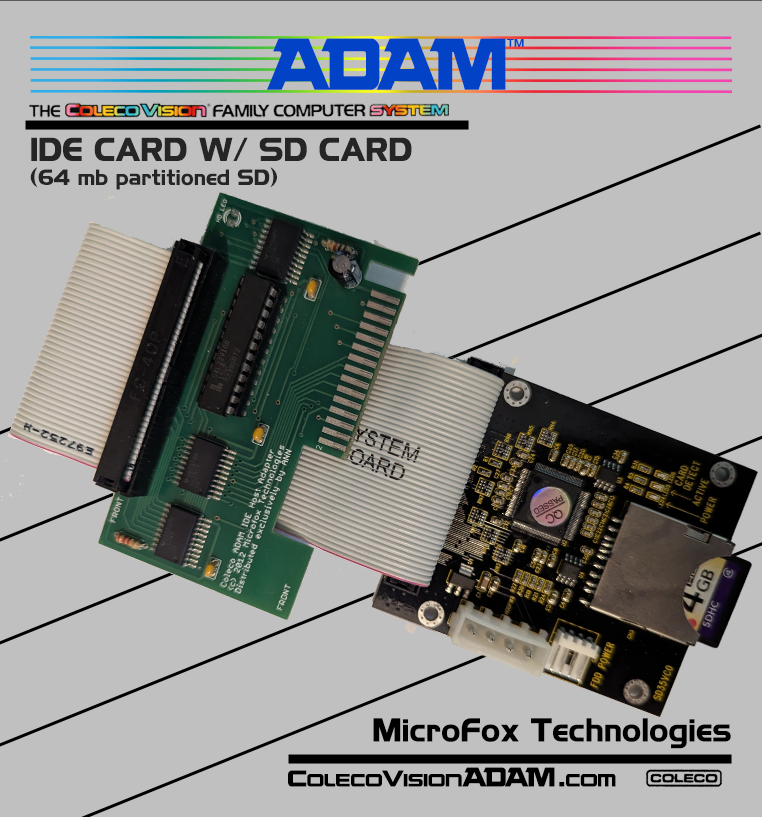
IDE Card with SD Storage (SD35VC0) Slot #1This pairing turns the MicroFox IDE Host Adapter into a modern solid-state storage solution for the Coleco ADAM. The green IDE Host Adapter (© 2012 MicroFox Technologies, distributed exclusively by ANN) seats in expansion slot #1 and connects through a 40-pin IDE ribbon cable to a black SD35VC0 SD-to-IDE adapter, which presents an SD card to the ADAM as a standard IDE hard drive. The SD35VC0 is a later-generation adapter in a 3.5" hard-drive form factor: a consolidated FPGA/MCU performs the full IDE-to-SD protocol translation in firmware, with dual power inputs (4-pin Molex and floppy-style FDD), labeled status LEDs (Card Detect, Active, Power), and standard drive mounting holes for clean installation. It supersedes the earlier bare CompactFlash/SD carrier boards that relied on minimal passive logic. The IDE boot-cart ROM scans device IDs $04–$08, mapping the first five to hard-disk partitions and activating Coleco's dormant 4-drive expansion IDs ($06/$07) via boot-time EOS hot-patches. A typical power-user layout splits the partitioned SD card between EOS partitions (for ADAM SmartBASIC and native software) and TDOS partitions (for the CP/M environment) — for example, 10 EOS + 4 TDOS. Collected
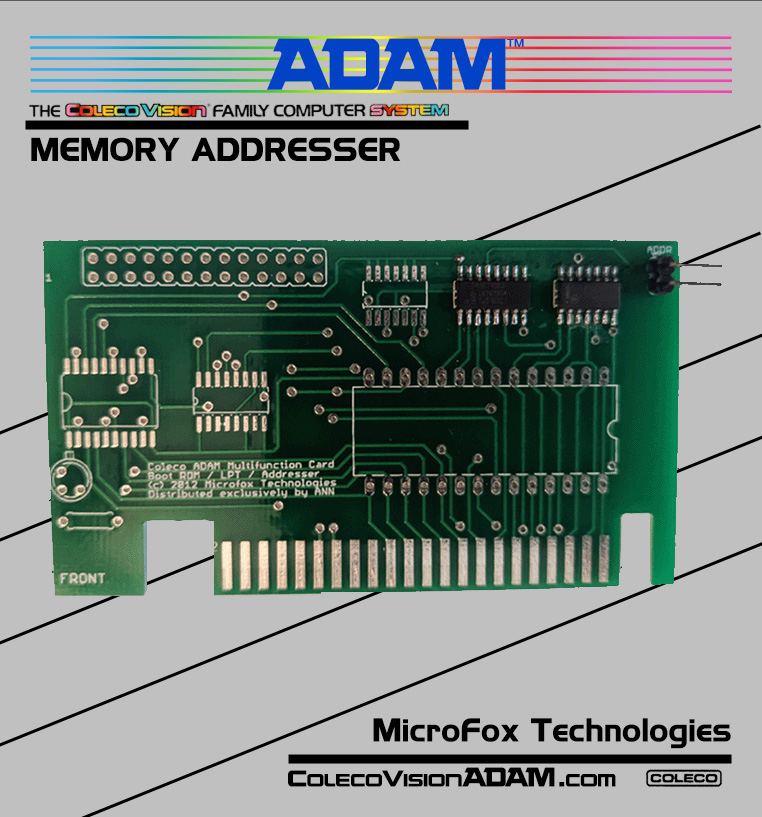
MF Memory Interface Slot #2MicroFox's take on the memory "addressor": a slot #2 interface board that generates the addressor signal which MicroFox (and other) RAM cards larger than 64K require to make their extra memory reachable by the ADAM. Installs in expansion slot #2. Collected
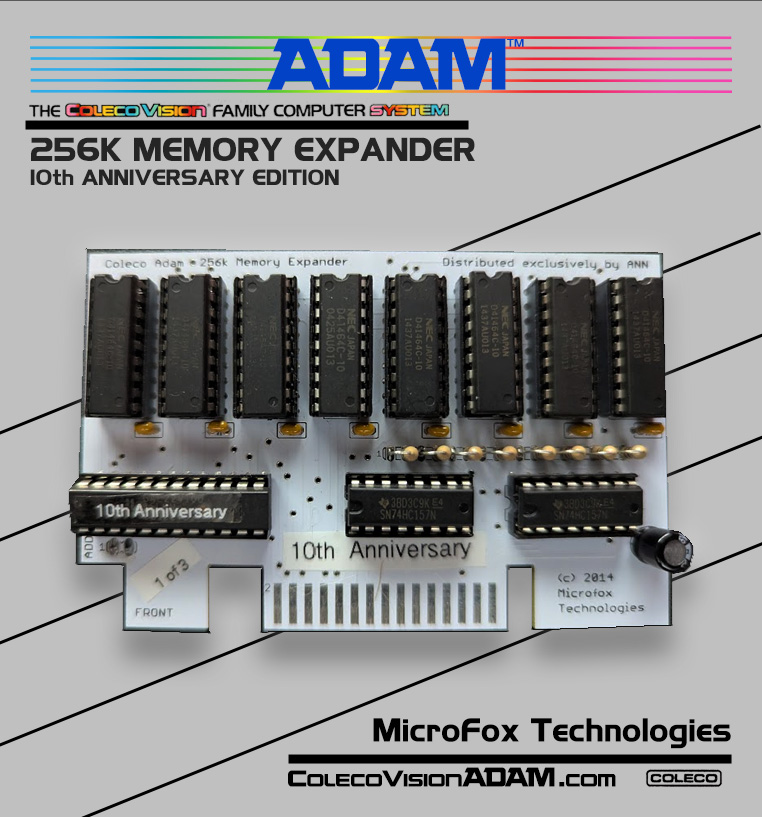 MicroFOX10th Anneversary Special Edition 256k Slot #3A special 10th-anniversary edition of MicroFox's 256K memory card. It adds 256K of RAM (about 320K system total); like every expander beyond 64K it needs an "addressor" signal from an interface board, and the extra space is typically used as a fast CP/M or T-DOS RAM disk. Installs in expansion slot #3. Collected
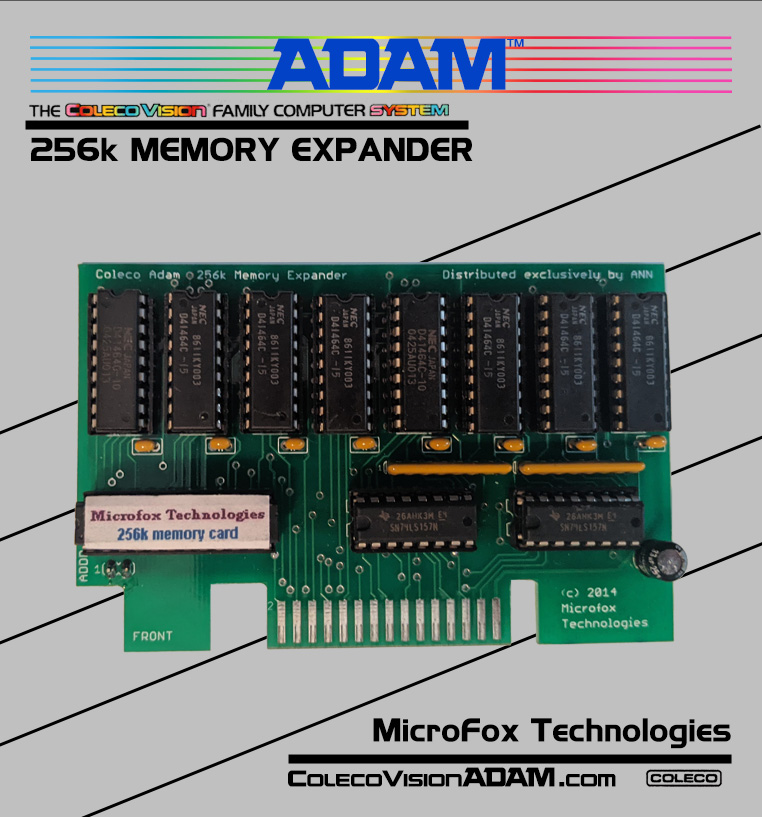
Microfox256k Slot #3MicroFox's standard 256K memory card, adding 256K of RAM for roughly 320K system total. As with all expanders over 64K it requires an "addressor" signal from an interface board, and the added memory is most useful as a fast CP/M or T-DOS RAM disk. Installs in expansion slot #3. Collected
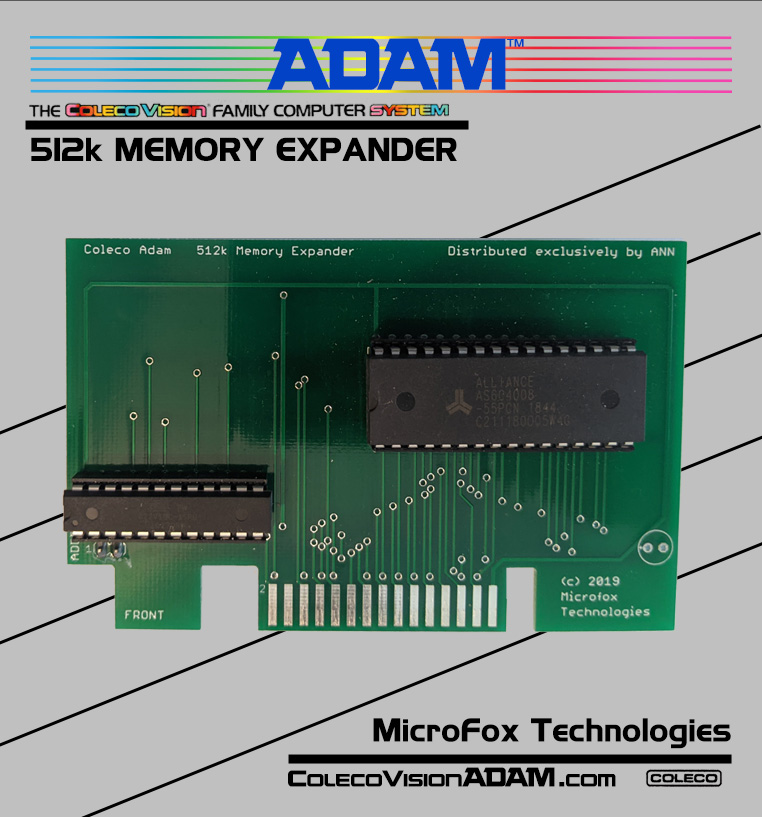
Microfox512k Slot #3MicroFox's 512K memory card, adding half a megabyte of RAM (about 576K system total). Like all expanders over 64K it relies on an "addressor" signal from an interface board, with the extra memory typically used as a fast CP/M or T-DOS RAM disk. Installs in expansion slot #3. Collected
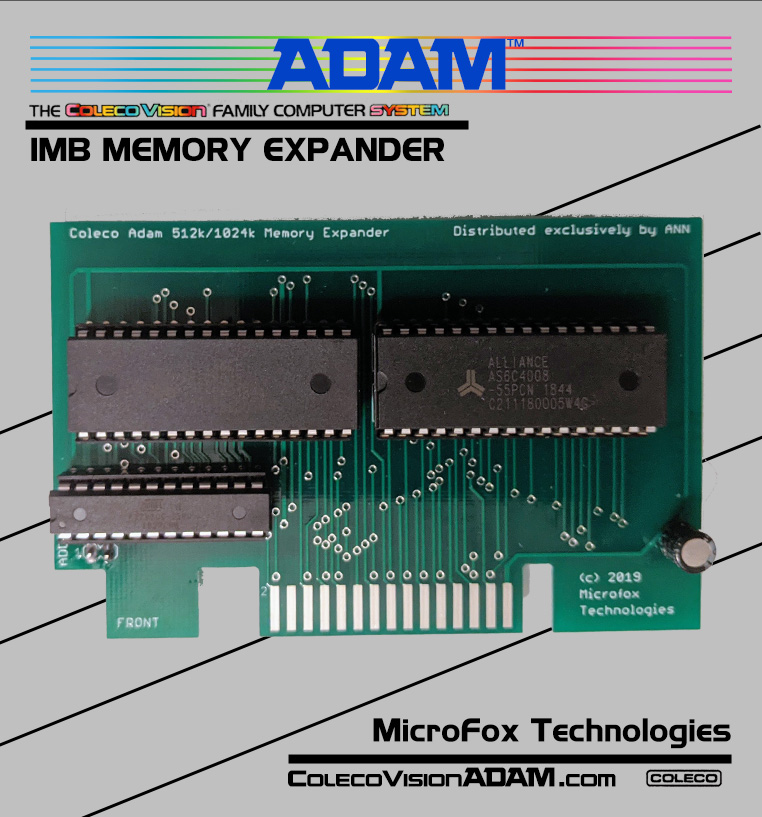
MF 1MB Slot #3MicroFox's largest memory card, adding a full megabyte of RAM (about 1088K system total) for the maximum practical expansion. It needs an "addressor" signal from an interface board, and the memory is normally used as a large, fast CP/M or T-DOS RAM disk — though some programs (such as PowerPaint) will only use part of it. Installs in expansion slot #3. E&T SOFTWARE
Collected
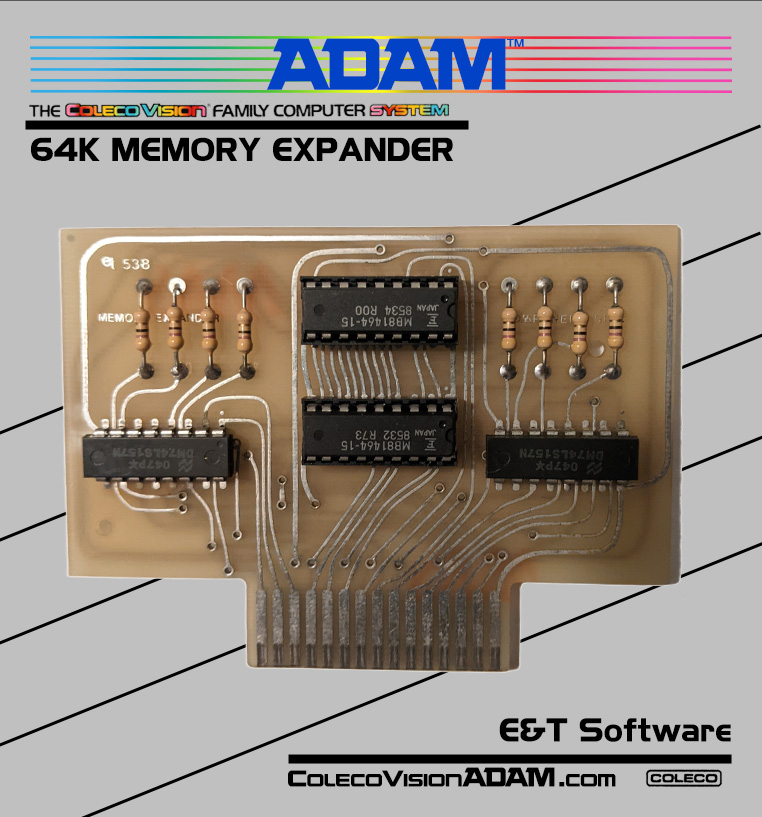
E&T 64k Slot #3A 64K memory expander from E&T Software, one of the third-party companies that kept the ADAM alive after Coleco exited the market. It adds 64K of RAM (144K system total) for a larger SmartWriter workspace and RAM-disk use under CP/M. Installs in expansion slot #3. Collected
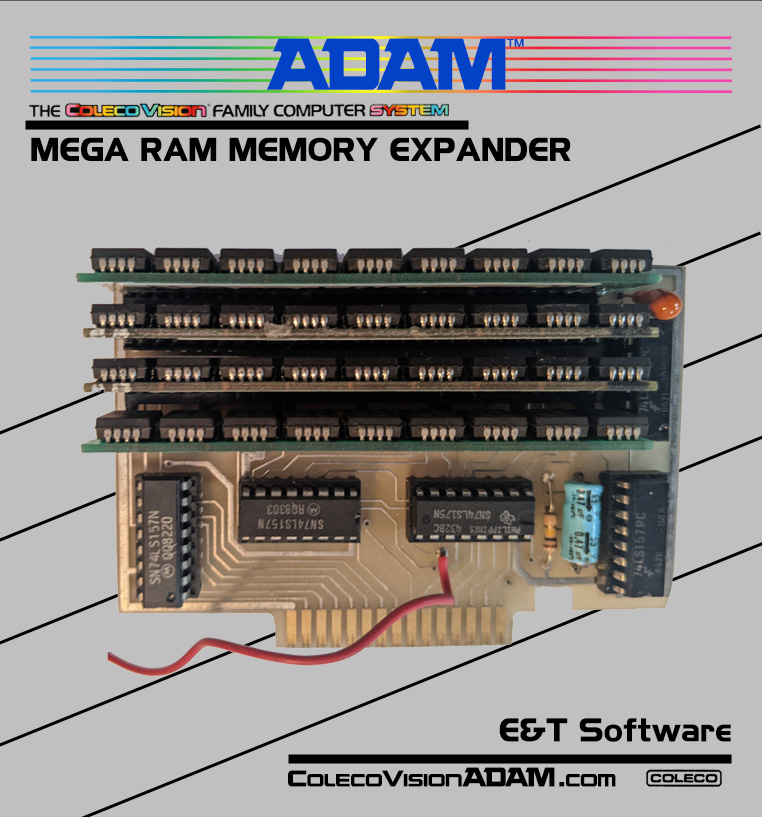
Mega Ram Slot #3This is by far the most "state of the art" memory expansion card for the ADAM in terms of capacity. Built to resemble the Orphanware MI-256K cards, this version uses the newer high capacity SIP units for storage rather than the older ram-chips. Each SIP provides 256K of memory. The board will hold a total of 4 SIPs giving the ADAM a full 1 meg of ram-disk memory Collected
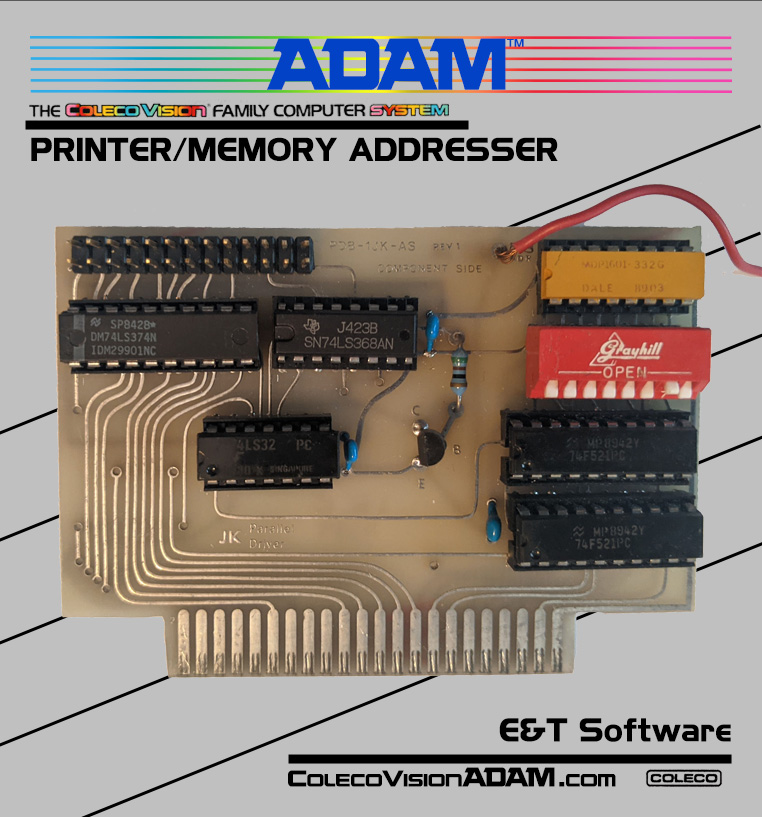
Printer InterfaceSlot #2A parallel (Centronics) printer interface from E&T Software, letting the ADAM drive standard dot-matrix and other PC-style printers instead of being limited to Coleco's own daisy-wheel printer. Installs in expansion slot #2. THE BREWING ACADEMY
Collected
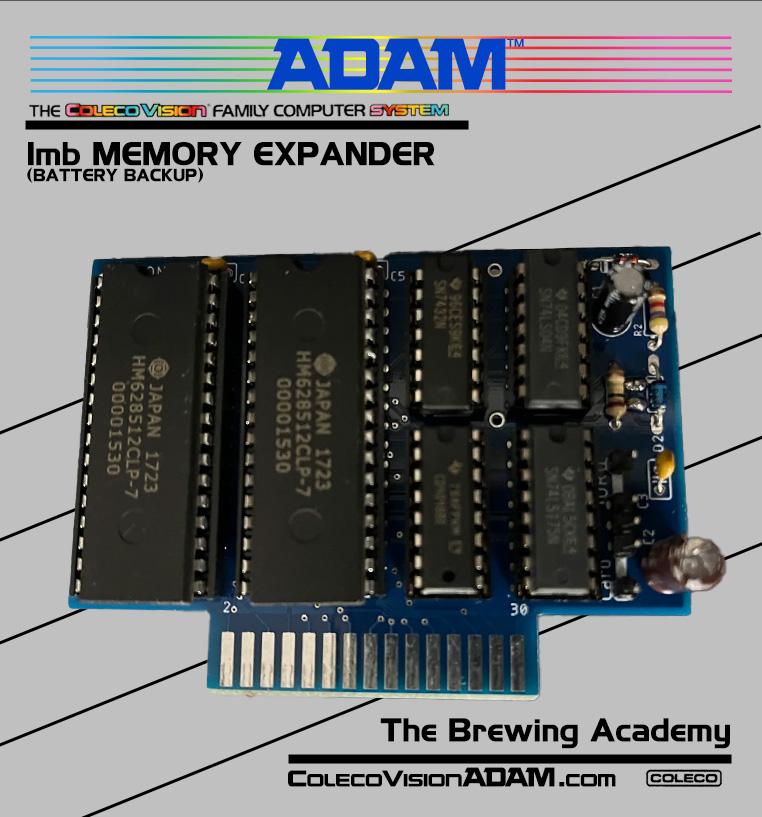
Brewing Academy 1MB Slot #3Mr. Charles Mouse's 8Mb (1MB) memory card for the Coleco ADAM. This one is very cool in that it has a battery backup, so if you are using it for a RAMDisk, the contents will stay as long as the battery has power! Installs in expansion slot #3. Collected
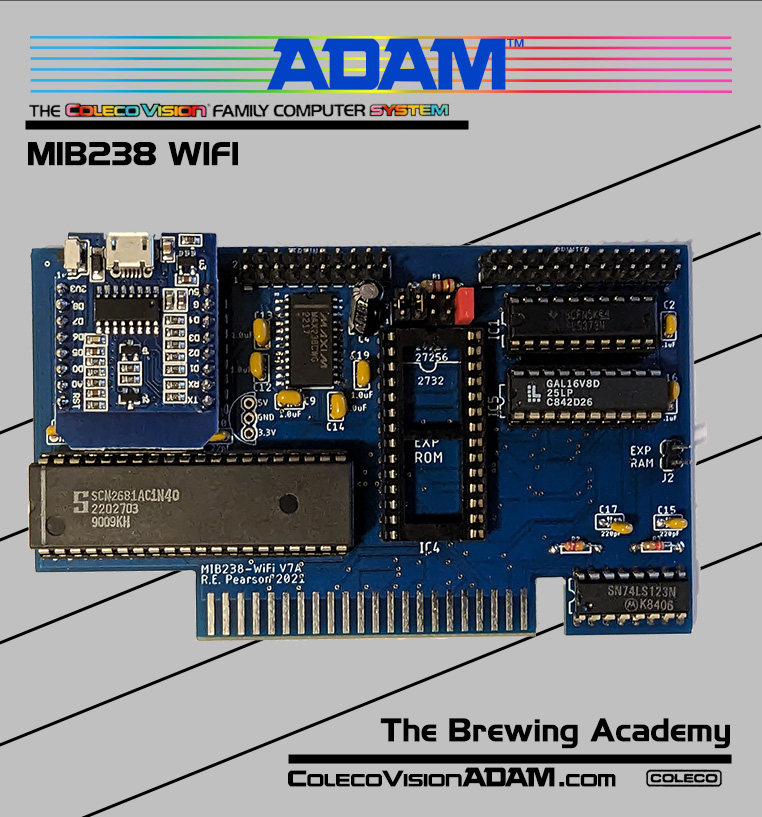
Brewing Academy MIB238 Slot #2Mr. Pearson's Multi-Interface Board 238. The Multipurpose Interface Board (MIB238 board) is a redesign of the Micro Innovations MIB3 board that only requires 5 volts using modern MAX238 transceivers. The MIB238, like the MIB3, adds a BOOT PROM socket, two RS-232 ports, a parallel port, and a memory expansion board addressor port to your ADAM computer. Available in MIB238 version 5 (standard) and version 7 (with WiFi adaptor). You also may choose to add on a BOOT EPROM. Installs in expansion slot #2. CAPITAL SOFTWARE
Collected
.jpg)
C-Interface Slot #1The Capital Software C-Interface (1985) is a third-party printer interface that let the Coleco ADAM print to standard dot-matrix printers via either the Commodore Serial Bus or Centronics Parallel. Designed by Thomas J. Golab, a one-man operation in St. Louis, Missouri, it is among the rarest documented ADAM peripherals. Installs in expansion slot #1. The card uses five standard TTL ICs (7406, 74LS32, 74LS175, 74LS368, 74LS30) with no dedicated protocol chip — all printer protocols are bit-banged in Z80 software through the CDRIVER binary. A 6-pin DIN cable routes through a user-drilled hole in the expansion cover to the printer, or to an MW-302C Centronics adapter. OTHER MANUFACTURERS
Collected
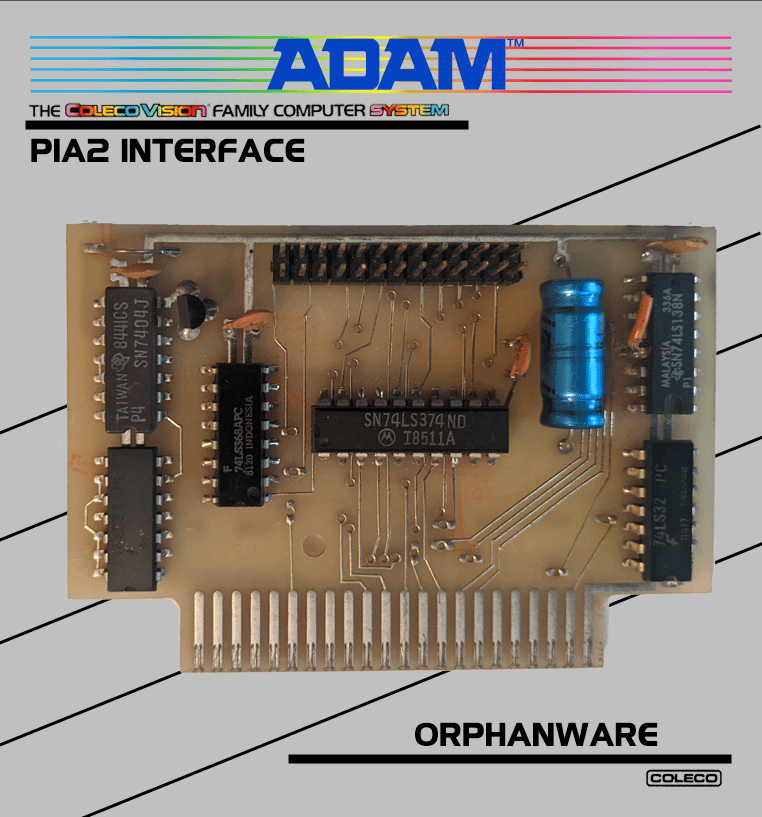
Orphanware PIA2Slot #2Orphanware's Parallel Interface Adapter — a parallel (Centronics) printer card for the ADAM that also supplies the memory-expander "addressor" signal. It uses Orphanware's Fastpatch software to patch the ADAM's EOS operating system so that standard parallel printers work in place of the Coleco daisy-wheel printer. Installs in expansion slot #2. Collected
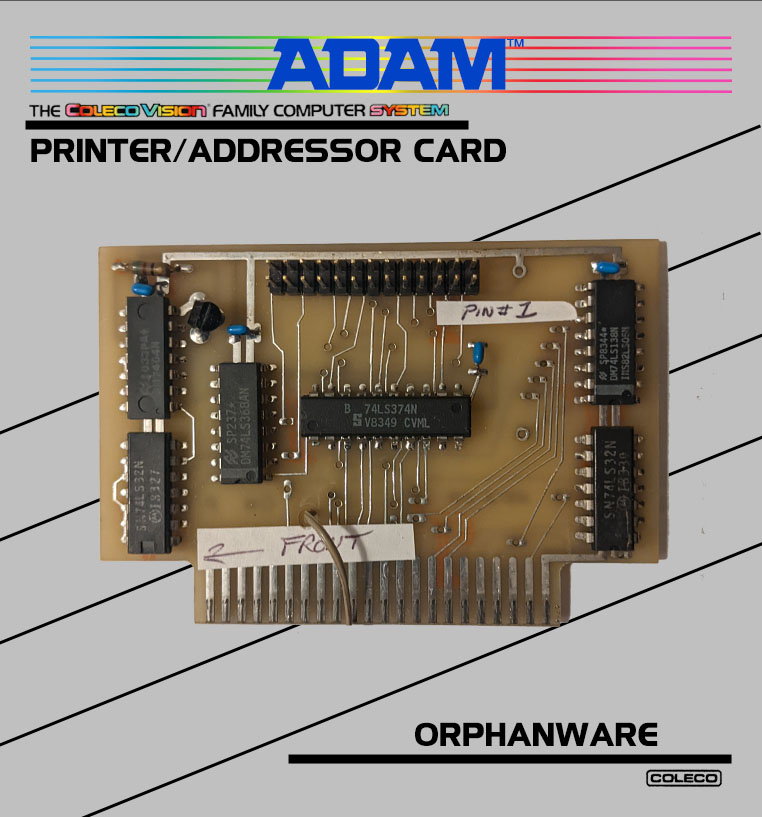
Print Address InterfaceSlot #2A center-slot card combining the ADAM's two most-requested functions: a parallel (Centronics) printer port and the memory-expander "addressor" signal that RAM cards over 64K require — both on a single board. Installs in expansion slot #2. Collected
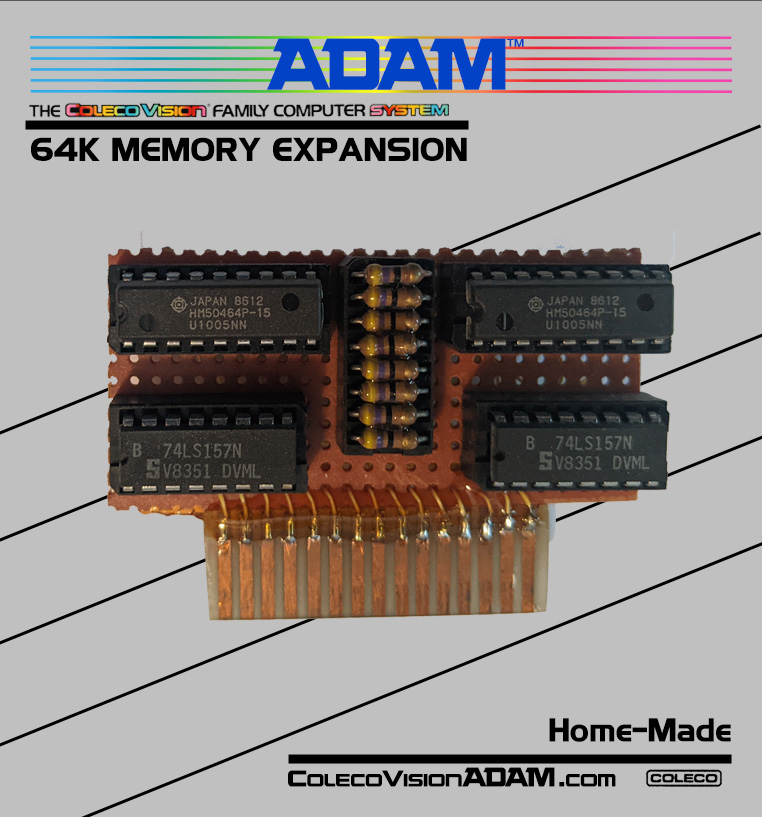
Generic 64K Memory ExpansionSlot #3An unbranded 64K memory expander, functionally the same as Coleco's: it adds 64K of RAM (144K system total) for a larger SmartWriter workspace and RAM-disk use. Several companies and hobbyists produced compatible 64K cards for the ADAM. Installs in expansion slot #3. Collected
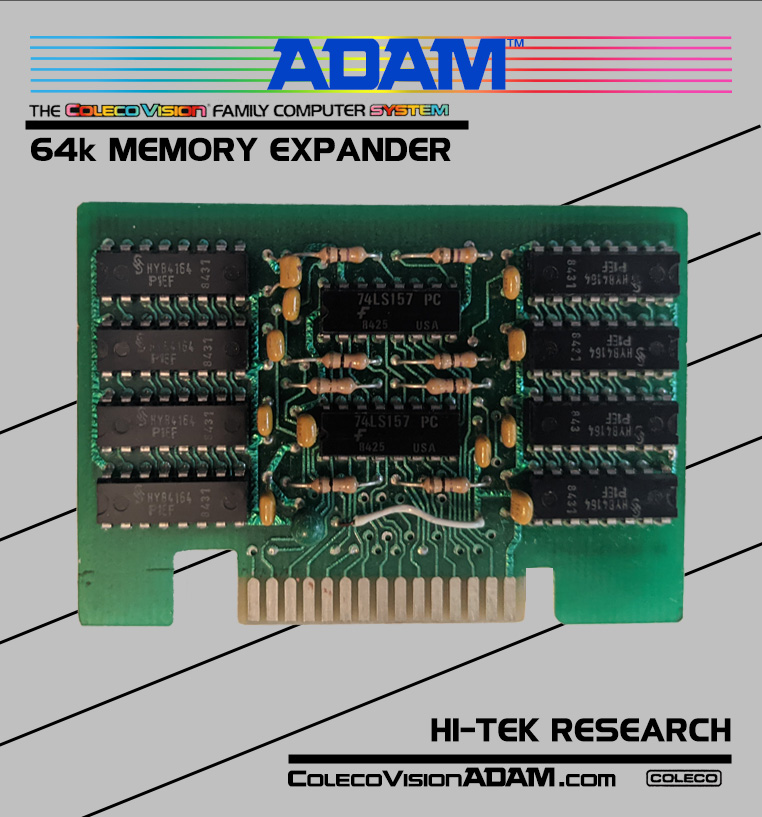
HiTek 64K Memory Expansion Slot #3Adds 64K bytes of RAM to give the ADAM system a total of 144K Random Access Memory. Installs in expansion slot #3. Collected
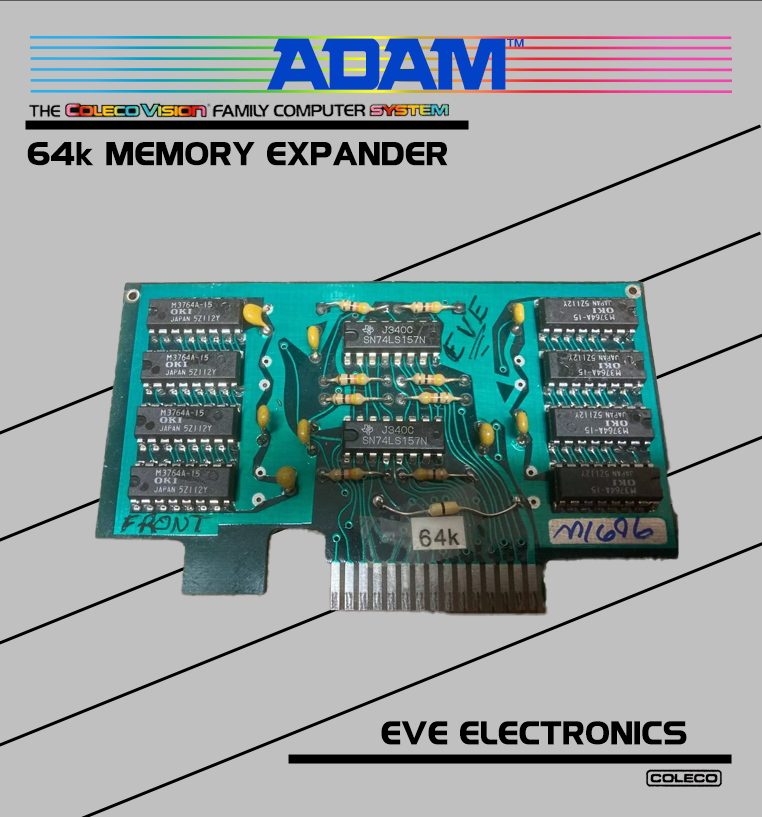
EVE 64K Memory ExpanderSlot #3Soon after Coleco decided to sell the 64K card, financial problems hit Coleco, and all of their hardware began a steady "phase out" by Coleco Electronics. In an effort to keep the memory expander around for ADAM owners, EVE Electronics did a superb job of duplicating the Coleco 64K card. Collected
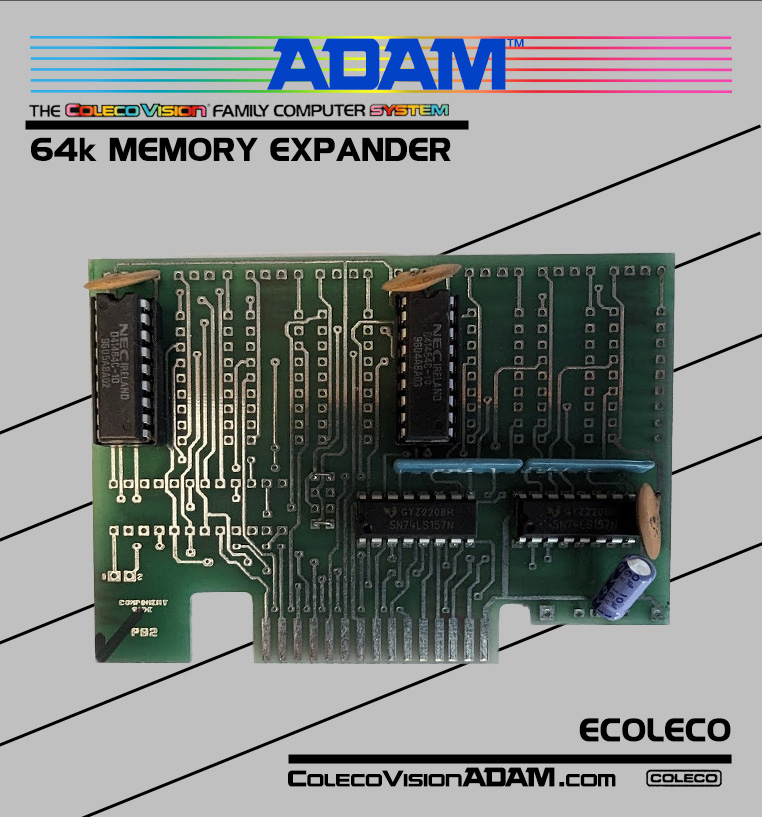
eCOLECO 64K MemorySlot #3A 64K memory expander carrying the "eCOLECO" name, bringing the ADAM to 144K total like the other 64K cards on this page. Installs in expansion slot #3. Collected
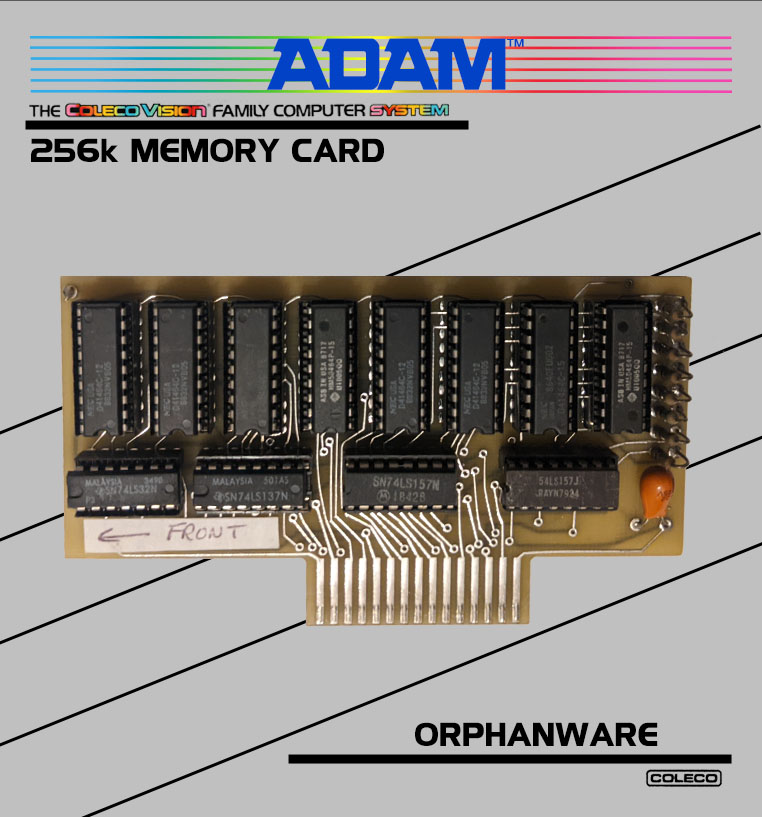
Orphanware 256K MemorySlot #3These units were made available with ram-chip sockets onboard. ADAM owners could purchase a blank board to which they could later add memory, as funds demanded or funds made possible. Those chips varied in price a great deal for a while. Any 64K increment could be purchased already built onto the expanders. Enhanced copy programs utilize these larger expanders, as does newer software; to extend the powers of SmartBASIC and other EOS software.. Collected
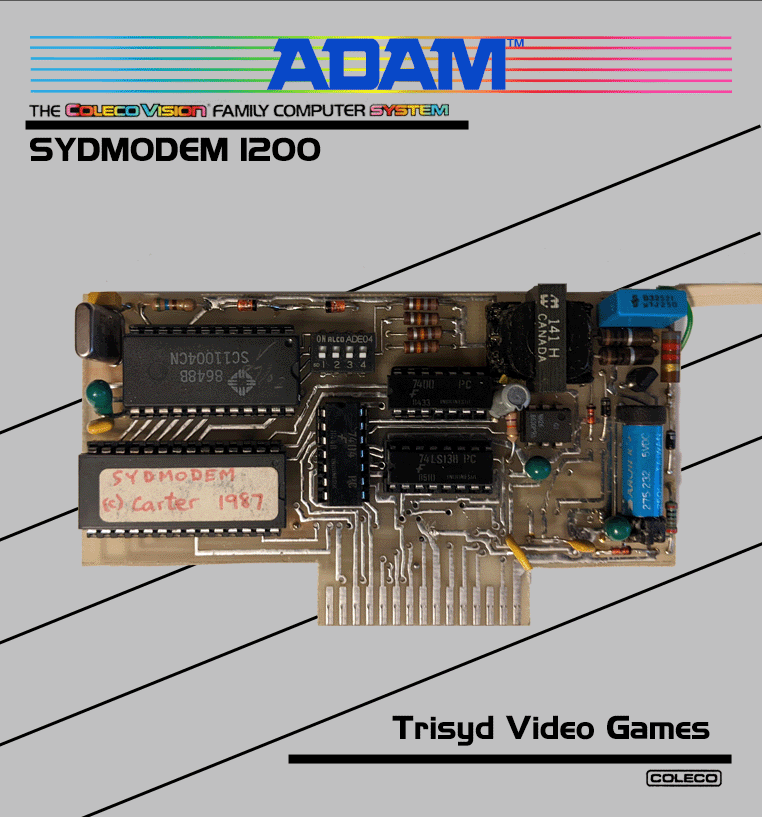
TRYSID SYDMODEM Slot #11200 baud Hayes compatible modem upgrade to replace the Coleco 300 baud in slot #1. Collected
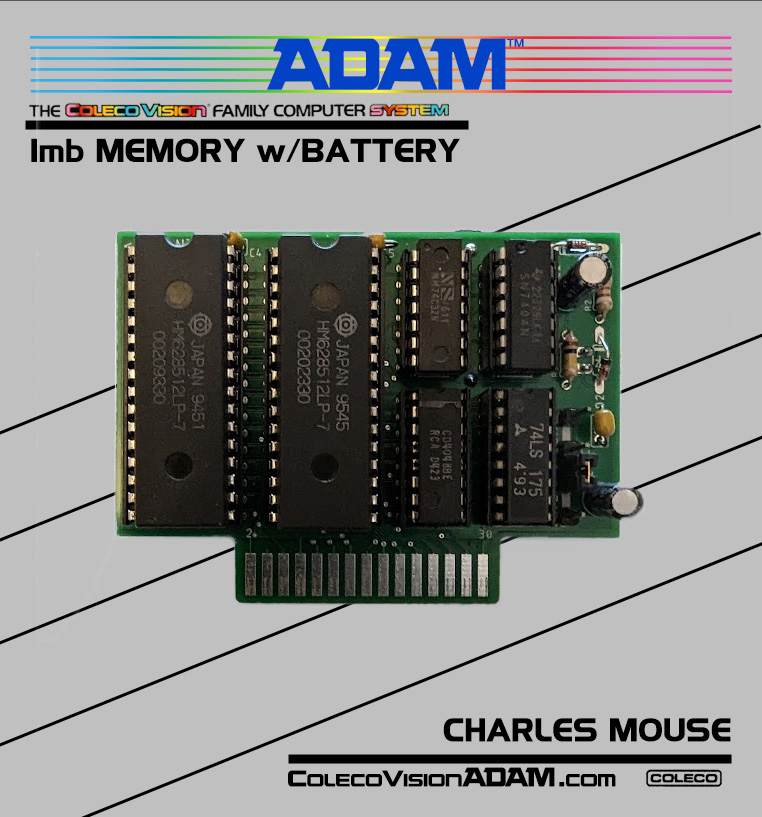
Charles Mouse 1MB MemorySlot #3A 1MB memory expander designed by Charles Mouse. It adds a full megabyte of RAM (about 1088K system total); like all large expanders it needs an "addressor" signal from an interface board and is typically used as a fast CP/M or T-DOS RAM disk. See also the battery-backed Brewing Academy 1MB above, which is built on the same designer's work. Installs in expansion slot #3. 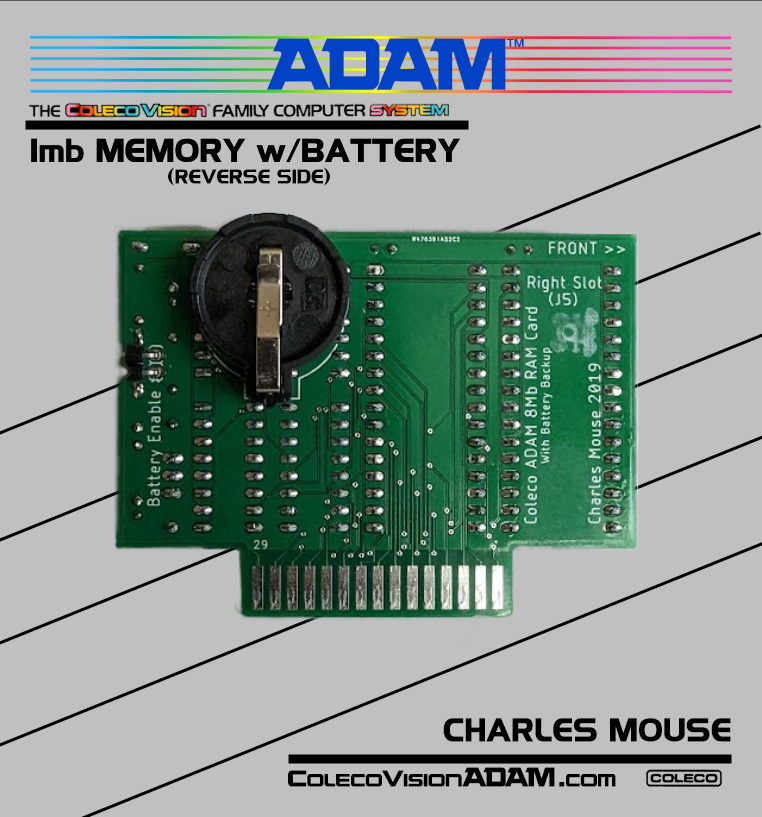
Collected
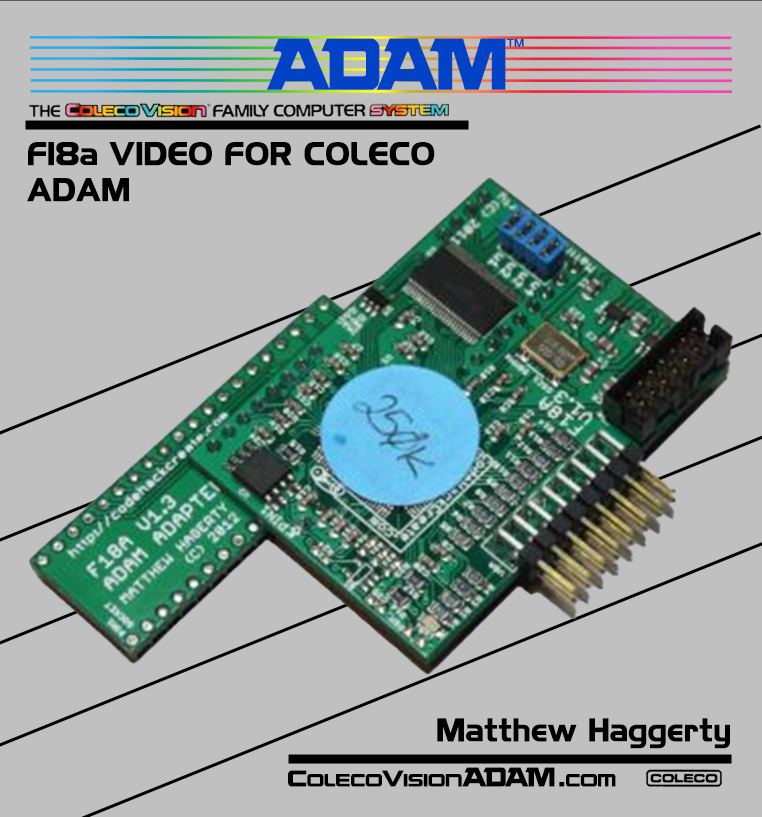
F18A VDP Replacement (Haggerty)F18A Video Display Processor replacement board by Haggerty. Provides enhanced video capabilities and compatibility improvements for the ADAM system. |
|||||
|
|||||




